Navy PRT Standards 2026: Minimums by Age and an 8-Week Plan
Navy PRT standards for push-ups, forearm plank and the 1.5-mile run by age and sex, how scoring works, the alternate cardio options, and an 8-week bodyweight plan to pass with room to spare.

Now on iPhone
Military Calisthenics Coach
Train military-style, one guided workout a day
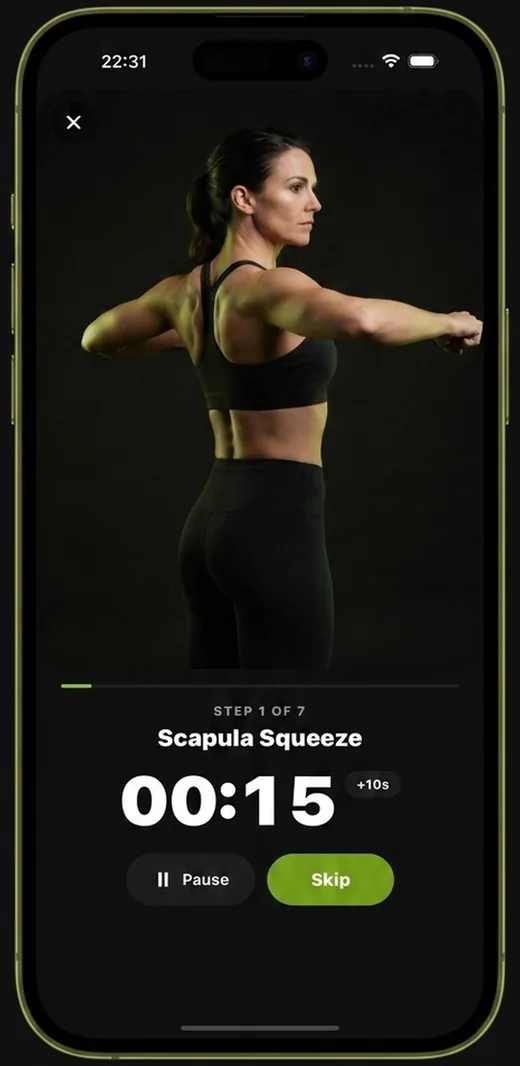
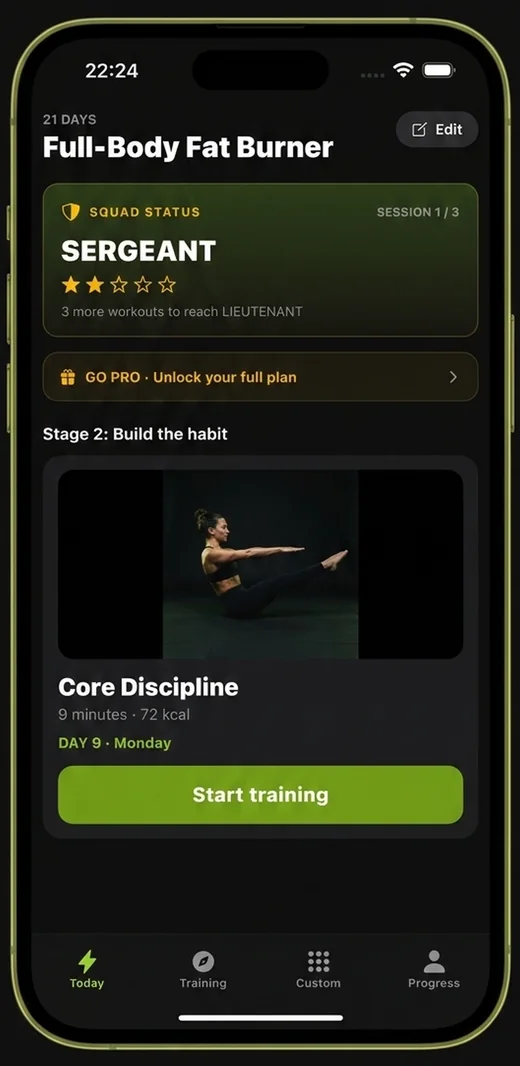
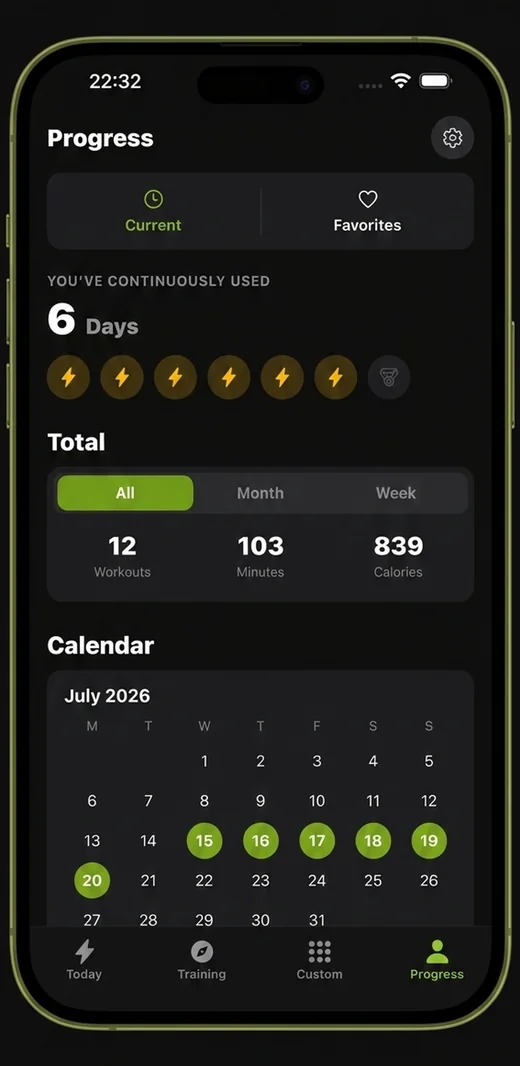
Military Calisthenics Coach is a 21-day military-style calisthenics program for iPhone: one guided bodyweight workout a day that you can run in a barracks, a garage or a hotel room, with timed sets and rests, ranks and streaks.
- A 21-day military-style program, one workout a day
- Guided timed sessions — no counting, no guessing
- Build your own sessions by time, body zone or focus

The Navy Physical Readiness Test is three events: push-ups for two minutes, a forearm plank for time, and a 1.5-mile run. You have to reach at least the Probationary level in every one of them, and the standard you need depends on your age and sex.
This guide gives you the minimum passing standards for every age group, explains how the scoring categories work, and finishes with an eight-week plan built on the same bodyweight training this site is about. The numbers below are taken from the Navy’s current test guide, OPNAV Physical Readiness Program Guide-5A, Physical Readiness Test (December 2025). Standards change, so check the latest guide on MyNavy HR before an official test.
The three events
| Event | What counts | Alternates |
|---|---|---|
| Push-ups | As many correct reps as you can in 2 minutes | None |
| Forearm plank | Time held in a correct position | None |
| 1.5-mile run | Time to complete the distance | 2,000 m row, stationary bike, treadmill, 500 yd or 450 m swim (at the CO’s discretion) |
All events are done on the same day, in that order, with 5 to 15 minutes of rest between them. Before the PRT, every sailor goes through the Body Composition Assessment (BCA). Active-duty and full-time support sailors are tested twice a year: cycle 1 runs from January to June, cycle 2 from July to December.
Minimum passing standards by age
These are the Probationary standards, the lowest score that still counts as a pass (45 points). Hit or beat all three for your age group.
Male
| Age | Push-ups (2 min) | Forearm plank | 1.5-mile run |
|---|---|---|---|
| 17–19 | 42 | 1:11 | 12:45 |
| 20–24 | 37 | 1:10 | 13:30 |
| 25–29 | 34 | 1:09 | 14:00 |
| 30–34 | 31 | 1:07 | 14:30 |
| 35–39 | 27 | 1:06 | 15:00 |
| 40–44 | 24 | 1:05 | 15:30 |
| 45–49 | 21 | 1:03 | 16:08 |
| 50–54 | 19 | 1:02 | 16:45 |
| 55–59 | 10 | 1:01 | 17:09 |
| 60–64 | 8 | 1:00 | 18:52 |
| 65+ | 4 | 0:58 | 20:35 |
Female
| Age | Push-ups (2 min) | Forearm plank | 1.5-mile run |
|---|---|---|---|
| 17–19 | 19 | 1:01 | 15:00 |
| 20–24 | 16 | 1:00 | 15:30 |
| 25–29 | 13 | 0:59 | 16:08 |
| 30–34 | 11 | 0:58 | 16:45 |
| 35–39 | 9 | 0:56 | 17:00 |
| 40–44 | 7 | 0:55 | 17:15 |
| 45–49 | 5 | 0:54 | 17:23 |
| 50–54 | 2 | 0:53 | 17:30 |
| 55–59 | 2 | 0:52 | 18:34 |
| 60–64 | 2 | 0:51 | 19:43 |
| 65+ | 1 | 0:50 | 20:52 |
Run standards apply below 5,000 feet of altitude; the guide allows more time above that. The alternate cardio events have their own tables in the guide.
Do not train for the minimum. A rep that the grader does not count, a plank that breaks five seconds early or a bad day on the run turns a bare pass into a failure. Aim to clear each standard by at least 20 percent in training.
How scoring works
Each event is scored in points, and points fall into categories:
| Category | Points |
|---|---|
| Outstanding (high / medium / low) | 100 / 95 / 90 |
| Excellent (high / medium / low) | 85 / 80 / 75 |
| Good (high / medium / low) | 70 / 65 / 60 |
| Satisfactory (high / medium) | 55 / 50 |
| Probationary | 45 |
Two rules matter. First, every event must reach at least Probationary. A maximum run does not rescue a failed plank. Second, your overall PRT category is based on the average of your event scores, so lifting your weakest event is usually the fastest way to raise the overall result.
Getting the push-ups right
The push-up is where most points are lost to form rather than fitness. Graders count only reps that meet the standard, and two minutes of uncounted reps feel exactly as hard as counted ones.
- Body straight from head to heels for the whole set. No sagging hips, no piked hips to make the bottom position easier.
- Full range. Lower until your upper arms are at least parallel to the deck, then press back to straight arms.
- Rest only at the top. You may pause in the up position with straight arms. Dropping a knee or resting on the deck ends the event.
Pacing matters as much as strength. Most sailors go out too fast and stall after the first minute. A steady rhythm of reps in clusters, such as sets of five with a breath at the top, usually beats an all-out start. For building the base, our push-up progression and the push-ups every day protocol both work well.
Getting the plank right
The forearm plank replaced curl-ups on the PRT. You hold a straight-body position on your forearms and toes, elbows under your shoulders, for as long as you can. The clock stops when you can no longer hold a correct position.
Holding a plank for time is mostly about two things: breathing and position. Brace your midsection as if someone were about to push you, keep breathing in short controlled breaths, and press the forearms into the deck to keep the shoulders from collapsing. Lock the position in during the first ten seconds; small adjustments late in the hold are where most breaks happen. Our calisthenics core workout has the accessory work that makes long holds easier.
Getting the run right
The 1.5-mile run is the event with the widest gap between passing and scoring well, and it responds well to training. Two sessions a week drive most of the improvement:
- Intervals: 400-meter repeats at a little faster than goal pace with equal rest. Start with four and build to eight.
- Easy aerobic run: 25 to 40 minutes at a pace where you can talk in full sentences. This builds the base that lets you hold goal pace for 1.5 miles.
Once a week, run the full distance at goal pace, or test it every two weeks. Know your splits: dividing your goal time by six gives you the time for each quarter mile.
The 8-week PRT plan
Three strength sessions and two run sessions per week. Do the strength work on non-consecutive days, and keep at least one full rest day.
| Week | Push-ups | Plank | Run |
|---|---|---|---|
| 1 | 5 sets at 50% of max reps | 4 × 50% of max hold | 4 × 400 m + 25 min easy |
| 2 | 5 sets at 55% | 4 × 55% | 5 × 400 m + 25 min easy |
| 3 | 6 sets at 55% | 4 × 60% | 6 × 400 m + 30 min easy |
| 4 | Test: 2-min max | Test: max hold | Test: 1.5 mi |
| 5 | 5 sets at 60% of new max | 3 × 70% of new max | 6 × 400 m + 30 min easy |
| 6 | 6 sets at 60% | 3 × 75% | 7 × 400 m + 35 min easy |
| 7 | 1 × 2-min max + 4 sets at 50% | 2 × 80% | 8 × 400 m + 35 min easy |
| 8 | Two light sessions, then rest | One light session | 4 × 400 m, then rest 2 days before the test |
Rest 60 to 90 seconds between push-up and plank sets. In weeks 4 and 7, practise the test order with the real 5 to 15 minutes between events, so the day itself holds no surprises. If you started below the minimum in any event, run weeks 1 to 4 twice before moving on.
Pair this with one session a week of pulling and leg work, for example from the military calisthenics workout plan, so the push-up volume does not leave your shoulders unbalanced.
How the Navy PRT compares
The Navy PRT is one of the simpler branch tests to train for: no bar, no weights, just push-ups, a plank and a run, so everything in the plan above can be done at home and on any road or track. The Marine Corps PFT adds pull-ups, and each branch scores its events differently. If you are comparing branches or preparing for more than one test, see our guides to the Marine Corps PFT, the Air Force PT test, the Coast Guard PT test and military fitness test standards across the services.
Frequently asked questions
What are the Navy PRT events?
Push-ups for two minutes, a forearm plank for time, and a 1.5-mile run. Commands can authorize an alternate cardio event instead of the run: a 2,000-meter row, stationary bike, treadmill, or a 500-yard or 450-meter swim. Push-ups and the plank have no alternates.
What is the minimum passing score on the Navy PRT?
At least Probationary (45 points) in every event. For a male sailor aged 20 to 24 that is 37 push-ups, a 1:10 plank and 13:30 on the run; for a female sailor aged 20 to 24 it is 16 push-ups, a 1:00 plank and 15:30.
How often do sailors take the PRT?
Active-duty sailors test twice a year, in a January–June cycle and a July–December cycle. Each cycle starts with the body composition assessment.
How long is the rest between PRT events?
Five to fifteen minutes, with all events on the same day. Train with that gap so the test-day order feels familiar.
How long does it take to train for the Navy PRT?
Eight weeks to move up a category or two if you already pass. If you are below the minimum in any event, plan for twelve weeks and repeat the first four weeks of the plan before moving on.