Can You Do Push Ups Every Day? The Truth About Daily Volume
Doing push ups every day can build endurance if managed correctly. Learn how to structure daily volume, use grease-the-groove, and avoid common overuse injuries.

Military Calisthenics Coach
Take the drill with you
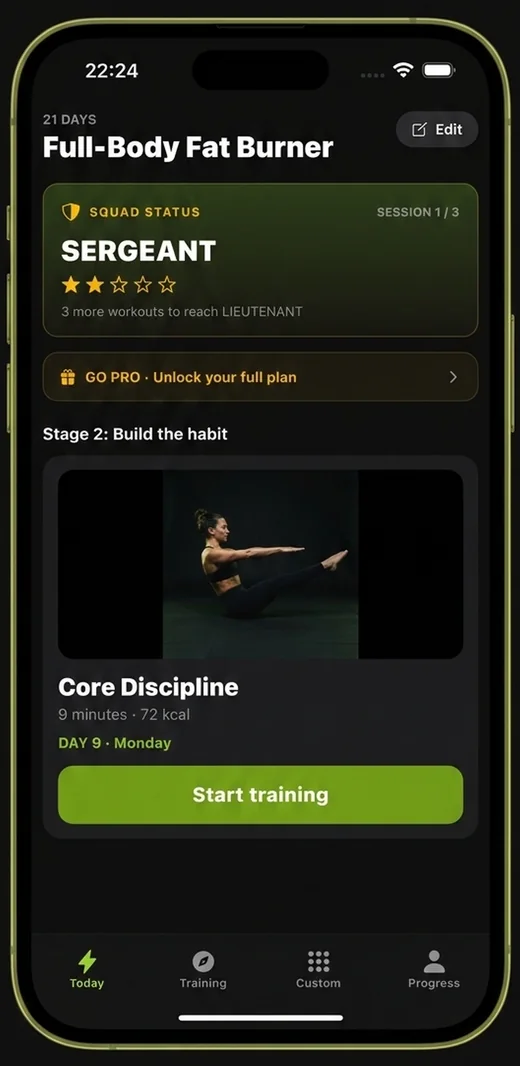
Everything on this site, built into a pocket coach. Military Calisthenics Coach turns the standards into a daily session you can run in a barracks, a garage or a hotel room — timed, tracked and scaled to you.
- A 21-day program that adapts to your level
- Guided timed sessions — no counting, no guessing
- Ranks, streaks and progress you can actually see



Performing push ups every day is a common goal for those seeking to build muscular endurance, but it requires a disciplined approach to avoid repetitive strain and stagnation. While many assume that more volume always equates to faster progress, the reality is that the body adapts to stress during recovery, not during the exertion itself. If you perform the same high-volume, fatiguing sets every single day, you likely bypass the recovery process required to build lean tissue, eventually leading to overuse injuries in the shoulders, elbows, and wrists. Instead of treating every session as a test of your maximum capacity, you must shift your mindset toward volume accumulation through sub-maximal training, often referred to as ‘grease-the-groove’. This method allows you to practice the movement pattern frequently without overloading your central nervous system to the point of failure.
The Problem With Daily Failure
Most beginners approach the idea of training daily by attempting to hit a new personal record in every session. They perform three sets to absolute failure, hoping that the exhaustion will force their muscles to adapt. In a military context, training to failure is occasionally required for specific fitness tests, but it is rarely the daily standard for conditioning. When you train to failure daily, your form inevitably breaks down. You start sagging your hips, shortening your range of motion, and flaring your elbows. These compensations put undue stress on the connective tissues of the shoulder girdle. If you are struggling with form, revisit push up progression to ensure you are building the foundation correctly before increasing your frequency.
Grease-the-Groove: The Smart Way to Train
Grease-the-groove, a concept popularized by veteran strength coaches, focuses on performing many sets of a movement throughout the day, far away from the point of failure. If your current maximum set is 20 reps, you do not perform 20 reps every hour. Instead, you perform 5 to 10 reps, several times throughout the day, for a total daily volume that is high but never fatiguing. This repetition builds neurological efficiency—the ability of your brain to coordinate the muscles involved in the push up more effectively. Over time, this makes the exercise feel easier, allowing you to hit higher totals without the extreme muscle soreness associated with traditional hypertrophy training.
Daily Volume Prescription
To apply this method safely, follow these specific parameters. If you are a beginner, do not start with a seven-day-a-week schedule. Start by practicing the movement four days per week, then gradually increase as your recovery capacity improves. Use this structure to maintain progress without burnout.
| Level | Reps per set | Total sets per day | Daily Target |
|---|---|---|---|
| Beginner | 5-8 | 3-5 | 15-40 |
| Intermediate | 10-15 | 4-6 | 40-90 |
| Advanced | 20+ | 5-8 | 100+ |
Remember that this is a guide, not a rulebook. If you feel sharp pain in your joints or your performance begins to drop significantly, you must take a rest day. Consistent training is the hallmark of what military calisthenics is, but consistency should not be confused with recklessness.
Ensuring High-Quality Movement Standards
In the military, standards are everything. A repetition that does not meet the specified range of motion is a repetition that does not count. For the push up, this means your chest must come within a fist’s width of the ground, and your elbows should track at roughly a 45-degree angle from your torso. Never sacrifice these standards for the sake of higher volume. If you find your form drifting, you are likely too tired to continue. If you are preparing for a structured challenge, incorporate the 8-week military calisthenics workout plan alongside your push-up practice to ensure you are training the antagonistic muscles, such as the back and lats, which are vital for shoulder health.
Preventing Overuse Injuries
Joint health is the limiting factor for most people who attempt high-frequency training. The wrists, in particular, often take a beating when performing high volumes of floor-based pressing. If you find your wrists are uncomfortable, switch to using push-up handles or calisthenics equipment that allows for a neutral grip. Furthermore, ensure you are balancing your pushing with pulling. A common mistake is to focus entirely on chest and triceps, leading to rounded shoulders and impingement. Make sure you integrate calisthenics back workout sessions into your weekly calendar. A strong upper back acts as a stable platform for the chest muscles to push from, effectively balancing your physique and reducing injury risk.
Integrating Into Your Broader Routine
Daily push ups should complement your primary training, not replace it. If you are looking to improve your overall conditioning, ensure you are still incorporating movements that challenge your heart rate and lower body. For those with limited space or time, the 20-minute no-gear barracks workout provides an excellent template for balancing push-ups with other movements. Treat your push-up practice as ‘skill work’ performed throughout the day, and keep your primary workout sessions focused on higher intensity and total body development. If you feel overwhelmed, start with calisthenics for beginners to build a baseline of strength before committing to high-frequency volume.
Frequently asked questions
How many push ups should I do a day to see results?
For most people, aiming for a total daily volume of 50 to 100 reps spread across multiple sets throughout the day is sufficient to see improvements in endurance and muscle definition. Focus on the quality of each repetition rather than rushing to hit the total number quickly.
How long does it take to get stronger with daily push ups?
With a structured approach like grease-the-groove, you can expect to see improvements in your maximum rep count within 4 to 6 weeks. Consistency is more important than raw effort; hitting your targets week after week will yield better results than sporadic, high-intensity attempts.
Can I do push ups every day if my shoulders hurt?
If you experience sharp or persistent pain in your shoulders, you should stop the daily volume immediately and allow for full recovery. Consult with a professional to ensure your technique is correct and that you are not suffering from an existing impingement or overuse issue.
What is the best way to track my progress?
Keep a simple logbook or digital note where you record your total daily repetitions and the number of sets it took to reach them. If you notice your form breaking down earlier in your sets over time, it is a sign that you need to lower your daily volume and focus on recovery.