What Is Military Calisthenics? A Complete Guide
What is military calisthenics? The bodyweight method armed forces use to build strength and endurance — its history, core exercises, standards and how to start.

Now on iPhone
Military Calisthenics Coach
Try military calisthenics with a coach in your pocket
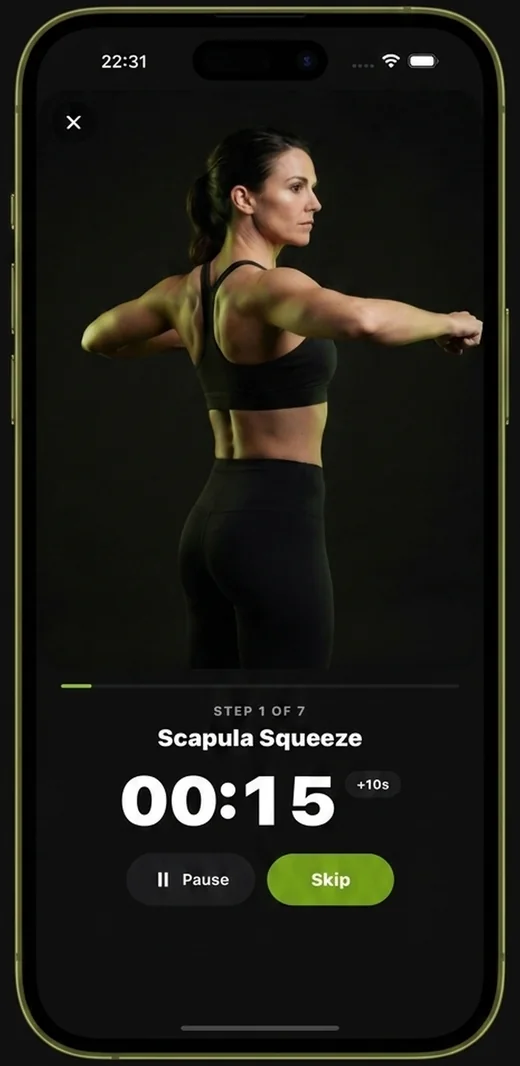
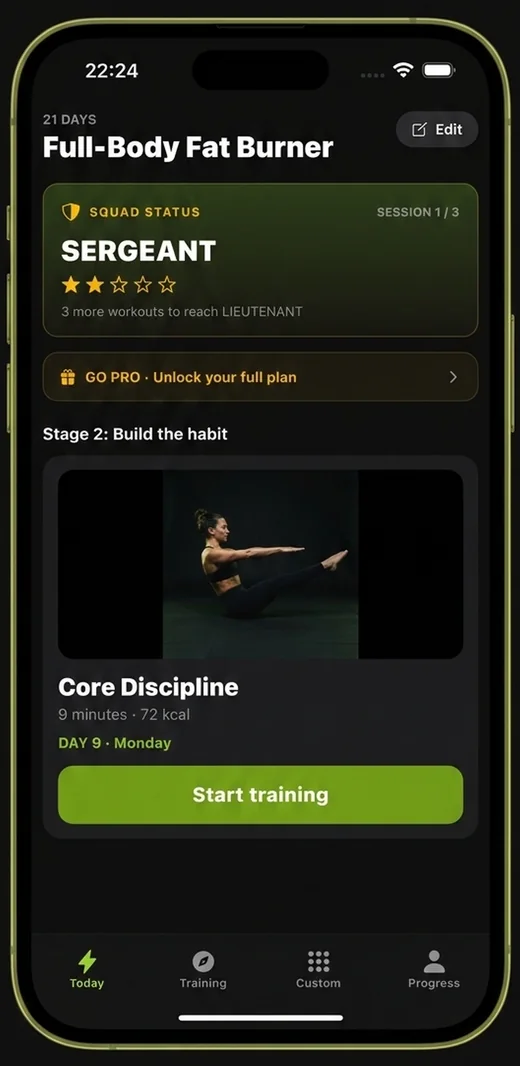
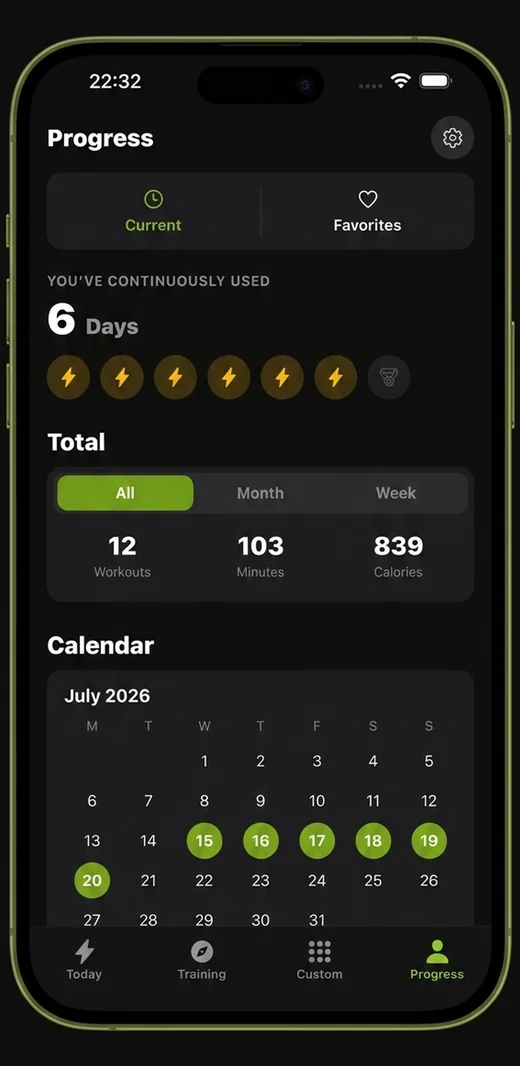
Military Calisthenics Coach is a 21-day military-style calisthenics program for iPhone: one guided bodyweight workout a day that you can run in a barracks, a garage or a hotel room, with timed sets and rests, ranks and streaks.
- A 21-day military-style program, one workout a day
- Guided timed sessions — no counting, no guessing
- Build your own sessions by time, body zone or focus

Military calisthenics is a system of bodyweight training — push-ups, pull-ups, squats, lunges, planks, sprints and carries — used by armed forces to build strength, muscular endurance and cardiovascular conditioning with little or no equipment. It prizes a small set of fundamental movements performed to a high standard, repeated with relentless consistency, and progressed by adding volume, slowing tempo or moving to harder variations rather than by adding external load.
If you have ever seen a platoon knocking out push-ups in the rain or a recruit grinding through pull-ups at dawn, you have seen military calisthenics. This guide breaks down exactly what it is, where it comes from, the exercises and principles that define it, the real fitness standards it is built to pass, and how to start training it yourself.
Military calisthenics, defined
“Calisthenics” comes from the Greek kalos (beauty) and sthenos (strength) — literally, strength built through movement of the body itself. Military calisthenics is the disciplined, test-driven branch of that tradition: the physical training (PT) method armed forces use to turn civilians into soldiers who can carry weight over distance, move under fatigue and recover fast.
What separates it from gym training is its constraints. A barbell needs a rack; a machine needs a gym. A soldier needs to be ready anywhere — a barracks, a ship, a forward base, a patch of dirt. So the method is built around three rules:
- Minimal equipment. A pull-up bar is the only real requirement; everything else uses your bodyweight and the ground.
- Fundamental movements. A handful of exercises, drilled until they are automatic, rather than dozens of isolation lifts.
- High, measurable standards. Every movement maps to a number on a fitness test you either pass or fail.
That combination — anywhere, basics, standards — is the whole philosophy in a sentence: master the fundamentals, hold the standard, repeat without excuses.
A short history of military calisthenics
Organised military PT is roughly two centuries old, and the shape of today’s sessions is a direct inheritance from it.
The nineteenth-century root is Swedish gymnastics, the system developed by Per Henrik Ling, which broke training into precise, unloaded movements that an instructor could command in unison. It spread through European armies because it solved a logistics problem more than a fitness one: it needed no equipment and scaled to whole formations at once.
The two world wars industrialised it. Armies facing mass conscription needed to take in civilians of wildly varying fitness and produce deployable soldiers on a schedule, so PT became standardised and testable — fixed movements, fixed counts, pass-or-fail. That is the era that fixed the push-up, the pull-up, the sit-up and the timed run as the canonical measures of a soldier’s body, and they have proved remarkably durable.
The modern shift is away from those simple counts toward job-task relevance. The clearest example is the US Army’s replacement of the decades-old APFT (push-ups, sit-ups, two-mile run) with the Army Combat Fitness Test, which adds loaded carries, a power throw and hanging leg tucks to better reflect what soldiering physically demands. Military calisthenics absorbed that change: the carries, drags and sprints you see in modern programming are there because the tests moved, and training follows the standard. You can see the current numbers in our guide to military fitness test standards and the Army Combat Fitness Test.
The through-line across all three eras is the same constraint: train anyone, anywhere, with nothing, against a number. Every design decision in the method falls out of that sentence.
Why armed forces train this way
Militaries did not choose bodyweight training because it is trendy. They chose it because it solves real problems that a weight room cannot.
- It is deployable. Training cannot stop because there is no gym. Calisthenics travels anywhere a soldier does.
- It scales to large groups. One instructor can lead a hundred people through push-ups and squats in cadence. You cannot do that with barbells.
- It is joint-friendly and repeatable. Bodyweight movements can be trained frequently with a lower injury rate than heavy maximal lifting, which matters when training has to continue day after day.
- It builds the right quality. Combat readiness is less about a one-rep max and more about doing hard physical work, repeatedly, while tired and carrying load. Calisthenics and conditioning train exactly that.
In other words, the method is a direct answer to the job. The same logic is why it works so well for civilians who want practical, transferable fitness without a gym membership.
The core exercises of military calisthenics
Military calisthenics has a small, deliberate vocabulary of movements. Master these and you have covered every major muscle group and movement pattern.
Pulling
The pull-up is the defining test of military fitness — you cannot fake it, and on most tests it is the single hardest standard. It builds the back, biceps and grip, and it is the movement most people need the most help with. If you are starting from zero, our dead hang to strict pull-up progression walks through the exact six stages from hanging off the bar to test-passing reps.
Pushing
Push-ups (and their harder cousins — diamond, archer and decline push-ups) plus dips build the chest, shoulders and triceps. Push-ups are the workhorse of military PT precisely because they need nothing but the floor and scale endlessly through hand position and tempo.
Legs
Air squats, walking lunges, step-ups and split squats build the legs and hips unilaterally — one leg at a time — which is exactly the strength a ruck march or a sprint-drag-carry demands.
Core and carry
Planks, hollow holds, leg raises and loaded carries train the trunk to hold posture under load. This is the unglamorous work that keeps you upright when the pack gets heavy — covered in depth in our guide to ruck-ready conditioning.
Conditioning
Running, sprints, burpees and circuits build the engine. A soldier who is strong but cannot move is not ready, so conditioning is woven into nearly every session.
You can see all five categories assembled into a single do-anywhere routine in our complete military calisthenics workout, and a zero-equipment version in the 20-minute no-gear barracks workout.
Military calisthenics vs. regular calisthenics vs. the gym
People often ask how military calisthenics differs from the calisthenics you see on social media, or from lifting weights. The movements overlap — the intent does not.
| Military calisthenics | Skill calisthenics | Gym / weights | |
|---|---|---|---|
| Goal | Pass fitness standards; work capacity | Skills (muscle-ups, levers, handstands) | Maximal strength / size |
| Measure | Reps and time against a test | Holding a skill | Weight on the bar |
| Equipment | Pull-up bar, bodyweight | Bars, rings | Full gym |
| Bias | Endurance + strength + engine | Strength + control | Strength + hypertrophy |
Military calisthenics is the most practical of the three. It will not give you a planche or a 200 kg deadlift, but it will make you genuinely hard to tire — and it asks for almost nothing to get started.
The principles that make it work
The exercises are simple. The results come from how you apply four principles.
- Progressive overload. Bodyweight does not mean easy. You progress by adding reps, adding sets, slowing the tempo, shortening rest, or moving to a harder variation. Without progression, you plateau.
- Greasing the groove (GTG). Spreading small, sub-maximal sets across the day — a few pull-ups every time you pass the bar — builds skill and strength fast without burning out. It is the single most effective trick for raising pull-up and push-up numbers.
- Volume over intensity. Military fitness rewards the ability to do a lot of work, not one heroic rep. Most progress comes from accumulating clean reps over weeks.
- Consistency above all. A modest workout done five days a week beats a brutal one done occasionally. The method is built for daily repetition, and that is where it pays off.
What a military calisthenics workout looks like
A typical session is short, full-body and run as a circuit or in blocks: a brief warm-up, then push, pull, legs and core work, finished with a conditioning piece such as a run or burpees. Thirty focused minutes is plenty.
Rather than reprint it here, follow our complete 30-minute military calisthenics workout, which lays out the exact sets and reps for a single session. Want a full program instead of one workout? The 8-week military calisthenics workout plan gives you beginner, intermediate and advanced tracks with a printable PDF. And for travel days without a bar, keep the no-gear barracks workout in your back pocket.
The fitness standards it is built to pass
Military calisthenics exists to pass real tests. The exact events and numbers vary by branch, country, age and sex — and they change over time — but most assessments combine an upper-body push, a core or pull movement, and a timed run. A few current examples:
- U.S. Army — ACFT (Army Combat Fitness Test): a six-event test including hand-release push-ups, a sprint-drag-carry, a plank and a two-mile run.
- U.S. Marine Corps — PFT: pull-ups (or push-ups), a plank, and a three-mile run.
- U.S. Navy — PRT: push-ups, a plank, and a 1.5-mile run or swim.
- British Army — RFT (Role Fitness Test): role-specific strength, carry and endurance assessments.
Because standards differ and are periodically revised, always train toward the current requirements for your specific branch and role. For a worked example of how standards differ — and why programming is sometimes adjusted — see our guide to military calisthenics for women.
Benefits — and honest limitations
Military calisthenics is one of the most accessible, transferable training methods there is. But no method does everything, and an honest guide says so.
Benefits
- Needs almost no equipment and works anywhere.
- Builds strength, muscular endurance and conditioning together.
- Joint-friendly and repeatable day after day.
- Scales from absolute beginner to advanced.
- Develops practical, transferable fitness — not just gym numbers.
Limitations
- It is not optimal for maximal strength or maximum muscle size; for those, added external load (weights) is more efficient.
- Progressing pulling strength can be slow without access to a bar.
- Programming still matters — random hard workouts cause burnout and injury, not progress.
The takeaway: military calisthenics is an outstanding foundation and, for most people, more than enough. If your goals later shift toward powerlifting or bodybuilding, you can add weights without ever abandoning the base it built.
Who it is for and how to start
The honest answer is almost everyone, because every movement scales. Push-ups can start on an incline; pull-ups can begin as dead hangs and slow negatives; rep counts can be halved. Beginners should prioritise clean form and gradually build volume before chasing test numbers.
A simple on-ramp:
- Week 1–2: Learn the movements. Three short sessions, focus on form, stop well short of failure.
- Week 3–4: Add a fourth day and start greasing the groove with pull-ups and push-ups.
- Week 5+: Follow a structured program like the 8-week military calisthenics workout plan, and pick the single movement you are weakest at to attack first — for most people, that is the pull-up.
Common beginner mistakes
- Chasing reps before form. A sloppy push-up trains sloppiness. Strict first, many second.
- Going to failure every set. It feels productive and quietly wrecks your recovery. Leave one or two reps in the tank most of the time.
- Skipping legs and conditioning. Upper-body vanity work is only a third of military fitness. The run and the carry decide tests.
- No progression plan. Doing the same workout forever stalls. Add reps, sets or difficulty on a schedule.
Frequently asked questions
Is military calisthenics good for building muscle? Yes, particularly for the upper body and core, as long as you apply progressive overload. For maximum size, eventually adding weighted variations or external load is more efficient.
Can I do military calisthenics every day? Most people thrive on four to five sessions a week with at least one rest day. Because it is low-impact, it tolerates more frequency than heavy lifting — but recovery still drives results.
Do I really only need a pull-up bar? For a complete program, yes. A bar covers pulling; the floor and your bodyweight cover everything else. A no-gear version exists for days without even that.
How long until I see results? Most people feel better conditioning within four to six weeks and see clear strength gains — like adding several strict pull-ups — within eight to twelve weeks of consistent training.
A note on trust and safety
This guide is part of an independent, educational resource on military-style bodyweight training; it is not affiliated with or endorsed by any armed force, and fitness-test standards are summarised for illustration and change over time — always confirm the current requirements for your branch and role. Training is physically demanding: progress gradually, prioritise form over numbers, and consult a qualified physician before starting any new exercise program, especially if you have an existing injury or medical condition.
Ready to train? Start with the complete military calisthenics workout, then pick your weakest movement and attack it: the pull-up progression for upper-body strength, ruck-ready conditioning for the engine, or the no-gear barracks workout when you are training on the road.