Military Calisthenics for Women: Standards, Strategy and Progressions
A complete guide to military calisthenics for women — the real fitness standards by branch, why female programming differs, and the progressions that close the upper-body gap.
Military Calisthenics Coach
Take the drill with you
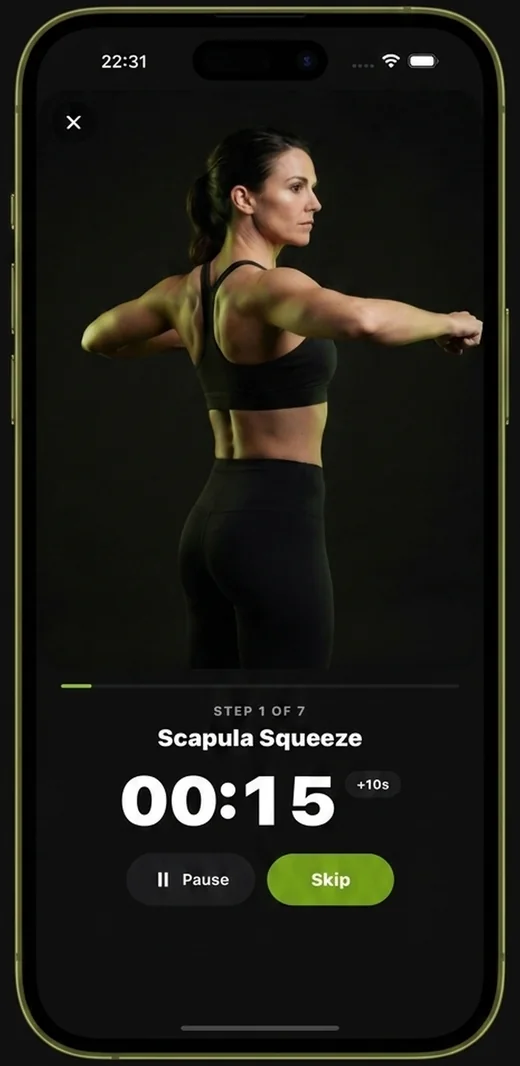
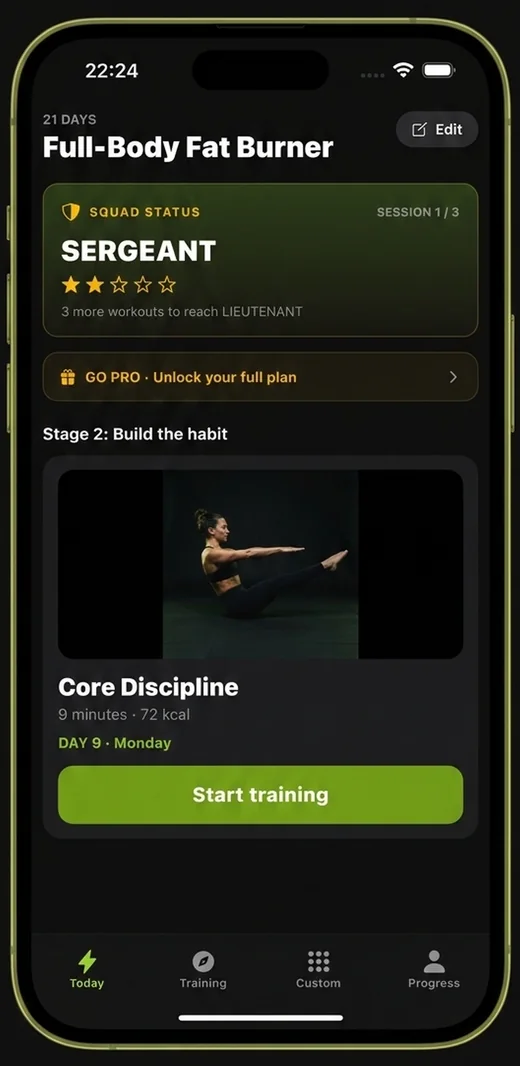
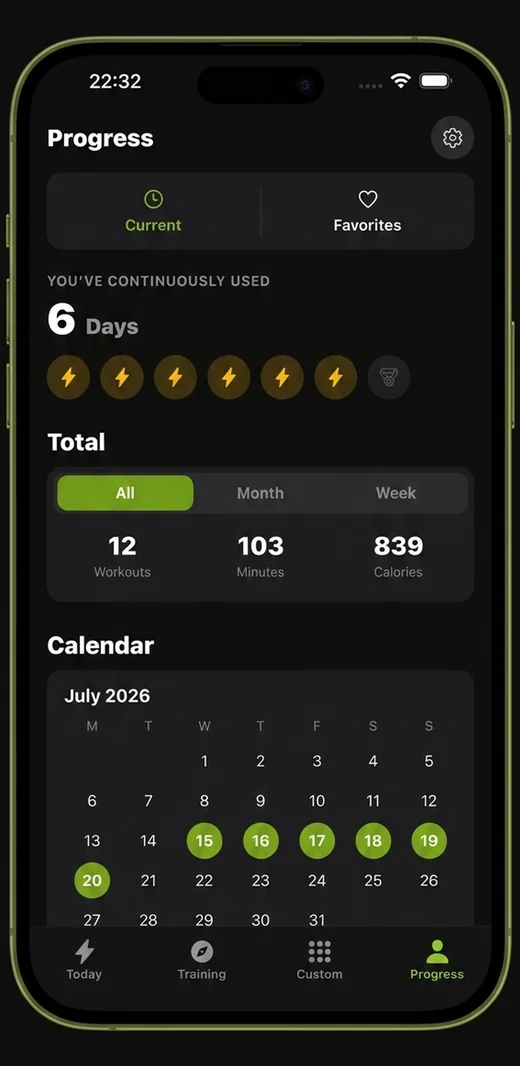
Everything on this site, built into a pocket coach. Military Calisthenics Coach turns the standards into a daily session you can run in a barracks, a garage or a hotel room — timed, tracked and scaled to you.
- A 21-day program that adapts to your level
- Guided timed sessions — no counting, no guessing
- Ranks, streaks and progress you can actually see

Women pass selection, carry rucks and hold the line in armed forces around the world — and they do it on the same bodyweight foundation everyone else trains. But how you build that foundation is not identical. Military calisthenics for women rewards a slightly different order of operations: prioritise the lift that the female body finds hardest, lean on the strengths most women already own, and program around physiology instead of pretending it doesn’t exist. If you are new to the method itself, start with what military calisthenics is and then return here for the female-specific strategy.
This is the field manual for doing exactly that — the standards you’re actually training toward, where the real gap is, and how to close it.
Do women need a different calisthenics workout?
The movements don’t change. Push-ups, pull-ups, squats, lunges, planks and running are the bedrock for everyone, and the daily military calisthenics workout on the front page is the same engine a woman should build. What changes is emphasis.
On average, women carry less of their muscle mass in the upper body and more in the lower body and hips. The practical consequences are consistent across thousands of trainees:
- Pulling and pressing strength is the limiter. The strict pull-up — already the hardest standard on most tests — is where the largest male/female performance gap sits. This is the lift to build the whole plan around.
- Lower-body and core endurance are relative strengths. Squats, lunges, hip-hinge work and longer holds tend to come faster, so they need progressive overload, not babying.
- Aerobic trainability is excellent. The run and ruck respond to consistent conditioning just as well — endurance is the great equaliser.
So no, you don’t need a separate, “lighter” routine. You need the same standards with the dial turned up on pulling strength and the patience to build it properly.
The real military fitness standards for women
Targets vary by country, branch, age and — in some tests — sex. Always confirm the current table for the force you’re testing with, because standards are revised often. As a realistic orientation, here is how women’s benchmarks commonly sit across English-speaking forces.
| Test element | Entry / pass | Competitive |
|---|---|---|
| Push-ups (2 min) | 15–19 | 40+ |
| Strict pull-ups | 1–3 | 7+ |
| Sit-ups / leg raises | 30–40 | 60+ |
| Plank hold | 1:30–2:00 | 3:00+ |
| 2-mile / 3.2 km run | ~21:00 | ~16:00 |
A few branch specifics worth knowing, because they shape how you train:
- US Army (ACFT). The Army Combat Fitness Test uses performance-normed scoring by age and sex, but the events are identical for everyone — hand-release push-ups, a deadlift, the sprint-drag-carry, plank and a 2-mile run. There is no separate women’s exercise list to hide behind.
- US Marine Corps. The Corps moved away from the old flexed-arm-hang-only option for women: pull-ups are now the scored standard, with the flexed-arm hang as a lower-scoring alternative. Training to pass means training real dead-hang pull-ups.
- British Army (RFA). The Role Fitness Assessment is gender-neutral and role-based — you’re held to the demands of the job, not your sex. Combat roles carry the same standard for women as for men.
The trend is unmistakable: forces are converging on gender-neutral, role-based standards. The flexed-arm hang as a permanent crutch is disappearing. That makes the pull-up non-negotiable — which is good news, because it’s the most trainable “impossible” lift there is.
Closing the gap: the pull-up is the mission
If you can already grind out push-ups and the run, your test score lives or dies on the bar. Most women start unable to do a single strict pull-up — and most women who train for it correctly get there inside 8 to 12 weeks.
The mistake is treating pull-ups as pass/fail and only practising the full rep. You build them in stages, exactly the way the full dead-hang to strict pull-up progression lays out:
- Dead hangs — own the grip and the shoulder position first. Accumulate time, not reps.
- Scapular pulls — the small range at the top of the hang that teaches your shoulder blades to drive the movement.
- Slow negatives — jump or step to the top, then lower for 5+ seconds. Negatives build pulling strength faster than almost anything else and are the single highest-leverage drill for women chasing a first rep.
- Band-assisted or foot-assisted reps — only as a bridge, never the destination.
- The first strict rep — then the second. From one clean rep, sets of singles with full rest add up surprisingly fast.
Train pulling three times a week, even on days you’re not doing a full session. Frequent, sub-failure practice beats occasional all-out grinding for a skill this strength-dependent.
A women’s military calisthenics plan (week structure)
This is a four-day week that runs the standard workout as its engine but front-loads the pull work where most women need it. Use the front-page session as your “full PT” template and layer this emphasis on top.
| Day | Focus | Priority work |
|---|---|---|
| Mon | Full PT + pull emphasis | Dead hangs / negatives first, then the session |
| Tue | Conditioning + core | Run or intervals; planks and hanging leg raises |
| Wed | Rest / mobility | Walk, stretch hips and shoulders |
| Thu | Upper-body strength | Push-up volume, negatives, scapular pulls |
| Fri | Lower body + carry | Lunges, step-ups, loaded carries |
| Sat | Long effort | Easy run or a loaded ruck |
| Sun | Rest | Full recovery |
Travelling or short on time? Swap any session for the 20-minute no-gear barracks workout — it keeps the streak alive when life gets in the way, which matters far more than any single perfect session.
Progress it like everyone else: add reps, add sets, slow the tempo, or move to harder variations. The standard is honest effort against last week’s numbers.
Training around your physiology
Two women-specific factors are worth programming around — not as limits, but as information.
The menstrual cycle. Many women find strength and power feel best in the first two weeks of the cycle (the follicular phase) and that fatigue and recovery needs rise in the days before menstruation. You don’t have to overhaul your week, but it’s smart to schedule your hardest pull-up and strength sessions when you feel strong and treat low-energy days as quality conditioning or mobility rather than forcing a personal best. Track how you respond — averages are a starting point, not a rule.
Pregnancy and postpartum. Bodyweight training can often continue through pregnancy and is a well-regarded way to rebuild afterward, but this is genuinely individual. Core and pelvic-floor demands change, and a flat-out plank or heavy straining is not always appropriate. Get clearance from a qualified medical provider and, postpartum, ideally a pelvic-floor physiotherapist before returning to high-tension calisthenics.
This article is general fitness information, not medical advice. If you’re pregnant, postpartum, or managing any health condition, clear your training plan with a qualified professional first.
Myths worth retiring
- “Calisthenics will make me bulky.” Bodyweight training builds lean, test-ready strength and muscular endurance. The “bulk” that worries people takes years of dedicated hypertrophy work and surplus eating to achieve — it does not happen by accident from pull-ups and push-ups.
- “I’ll never do a real pull-up.” The vast majority of women who train negatives and dead hangs consistently get their first strict rep. It is a strength skill, and strength skills respond to practice.
- “I should stick to the lower standard.” As tests go gender-neutral and role-based, training to a real standard is no longer optional for the roles worth wanting — and it’s the only thing that actually prepares you for the job.
The bottom line
Military calisthenics for women isn’t a watered-down version of the men’s plan — it’s the same standards with a smarter order of attack. Make the pull-up the mission, treat your lower-body and aerobic strengths as assets to keep loading, program with your physiology instead of against it, and show up with the consistency the work demands. Do that, and the only “women’s standard” you’ll care about is the one with your name at the top of it.
Start with the pull-up progression, run the daily workout as your engine, and build the carry capacity with ruck-ready conditioning.