USMC CFT: Events, Scoring Tables by Age and an 8-Week Plan
The Marine Corps Combat Fitness Test explained: the three events, the exact Maneuver Under Fire course, minimum and maximum standards for every age group, how scoring works, and an 8-week plan you can run with minimal gear.

Now on iPhone
Military Calisthenics Coach
Train military-style, one guided workout a day
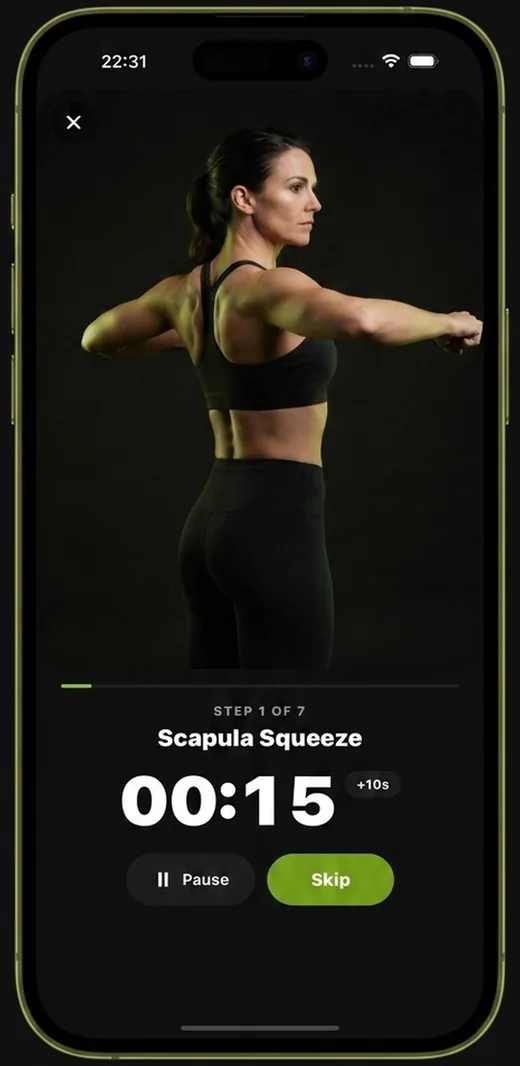
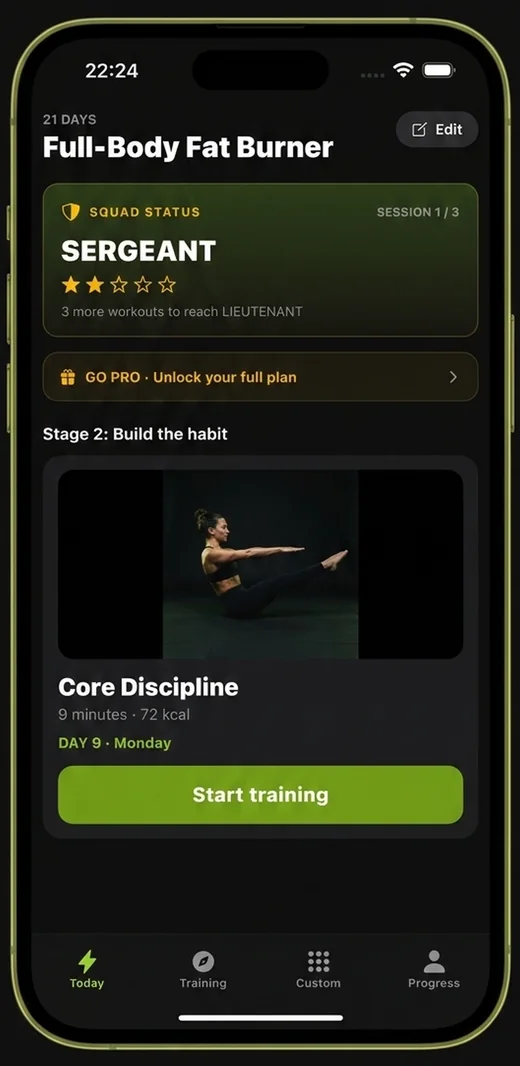
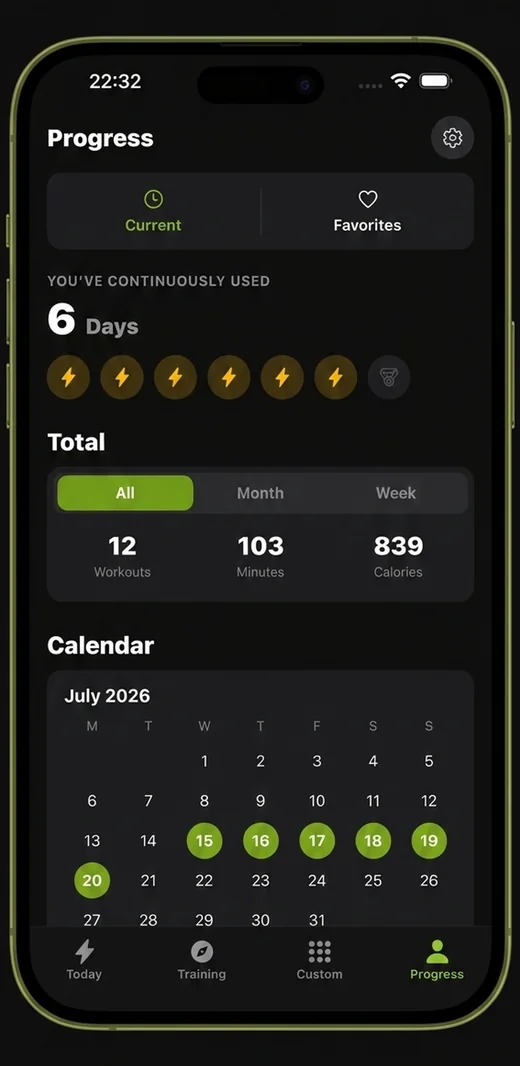
Military Calisthenics Coach is a 21-day military-style calisthenics program for iPhone: one guided bodyweight workout a day that you can run in a barracks, a garage or a hotel room, with timed sets and rests, ranks and streaks.
- A 21-day military-style program, one workout a day
- Guided timed sessions — no counting, no guessing
- Build your own sessions by time, body zone or focus

The USMC Combat Fitness Test (CFT) is three events done in boots and utilities, in a fixed order: Movement to Contact (an 880-yard run), the Ammunition Lift (a 30-pound ammo can pressed overhead for two minutes) and Maneuver Under Fire (a 300-yard shuttle with crawls, carries, a grenade throw and push-ups). Each event is worth 40 to 100 points. To pass you need at least 40 points in every event and 150 points in total.
This guide gives you the full minimum and maximum standards for every age group, the Maneuver Under Fire course yard by yard, and an eight-week plan built on bodyweight work plus a few simple loads. The rules and numbers come from MCO 6100.13A, Marine Corps Physical Fitness and Combat Fitness Tests (Change 4, March 2022, with an administrative update in May 2025). Standards can change, so confirm the current order with your unit’s Force Fitness Instructor (FFI) before an official test.
The three events at a glance
| Event | What you do | What is scored |
|---|---|---|
| Movement to Contact (MTC) | Run 880 yards on a measured, mostly level course | Time |
| Ammunition Lift (AL) | Lift a 30 lb ammo can from shoulder height to overhead | Reps in 2 minutes |
| Maneuver Under Fire (MANUF) | 300-yard shuttle with combat tasks (course below) | Time, plus or minus 5 s for the grenade |
The order never changes, and all three events are done in a single session of no more than two hours, with at least five minutes of rest between events. The uniform is the combat utility uniform and boots. You wear a green short-sleeve T-shirt for the Ammunition Lift so the grader can see your elbows lock, and the blouse goes back on for Maneuver Under Fire. Commanders may let Marines run the MTC without the blouse. Treadmills are not allowed for the MTC.
Active duty and reserve Marines take the CFT once a year, between 1 July and 31 December. The Marine Corps PFT covers the other half of the year.
Scoring: why the minimums are not enough
Each event is scored from 40 points (the minimum) to 100 points (the maximum) on tables set by age group and sex. Three rules decide whether you pass and how well you score:
- Every event needs at least 40 points. Missing the minimum in one event fails the whole test, whatever your total.
- The total needs to be at least 150. Three bare minimums add up to only 120, so you need 30 more points from somewhere.
- Your total sets your class:
| CFT class | Total points |
|---|---|
| 1st class | 235 to 300 |
| 2nd class | 200 to 234 |
| 3rd class | 150 to 199 |
In practice, the second rule matters most. A Marine who barely passes each event has still failed the test. Plan to score well above the minimum in at least two events.
Recruits are scored on the 17 to 20 tables whatever their age. Officer candidates, Basic School and Warrant Officer Basic Course students, and Naval Academy and NROTC midshipmen use their own age group.
Minimum and maximum standards by age
Each cell shows 100 points / 40 points. Times are minutes:seconds; the Ammunition Lift is reps.
Male
| Age | MTC | Ammo lift | MANUF |
|---|---|---|---|
| 17–20 | 2:40 / 3:45 | 106 / 62 | 2:07 / 3:17 |
| 21–25 | 2:38 / 3:45 | 115 / 67 | 2:04 / 3:18 |
| 26–30 | 2:39 / 3:48 | 116 / 67 | 2:05 / 3:22 |
| 31–35 | 2:42 / 3:51 | 120 / 67 | 2:10 / 3:30 |
| 36–40 | 2:45 / 3:58 | 110 / 67 | 2:16 / 3:42 |
| 41–45 | 2:52 / 4:11 | 106 / 66 | 2:23 / 3:59 |
| 46–50 | 3:01 / 4:28 | 100 / 65 | 2:40 / 4:14 |
| 51+ | 3:05 / 5:07 | 95 / 16 | 2:52 / 6:09 |
Female
| Age | MTC | Ammo lift | MANUF |
|---|---|---|---|
| 17–20 | 3:19 / 4:36 | 66 / 30 | 2:55 / 4:53 |
| 21–25 | 3:13 / 4:41 | 74 / 30 | 2:45 / 4:34 |
| 26–30 | 3:10 / 4:45 | 75 / 30 | 2:42 / 4:40 |
| 31–35 | 3:12 / 4:46 | 72 / 30 | 2:49 / 4:44 |
| 36–40 | 3:18 / 4:55 | 70 / 30 | 2:53 / 4:56 |
| 41–45 | 3:25 / 4:58 | 62 / 28 | 2:57 / 5:01 |
| 46–50 | 3:39 / 5:26 | 53 / 26 | 3:35 / 5:06 |
| 51+ | 3:55 / 5:52 | 44 / 6 | 3:44 / 6:33 |
Points between these two ends come from the full scoring tables in the order, or from the official PFT/CFT calculator. Units at 4,500 feet or higher give Marines 30 days to acclimatize and score the MTC and MANUF on separate altitude tables. The Ammunition Lift has no altitude adjustment.
What changed in 2026. From 1 January 2026, MARADMIN 613/25 put Marines in combat arms MOSs on sex-neutral PFT scoring with a 210-point minimum. The public announcements of that change cover the PFT, not the CFT. If you hold a combat arms MOS, ask your FFI which CFT tables apply to you.
Movement to Contact: an 880-yard race
The MTC is a short, hard run. Even maximum-point times are over two and a half minutes, so it is too long to sprint and too short to pace like a distance run. Treat it as two halves:
- Lap one: fast but controlled. If your goal is 3:00, you want to pass the halfway point at about 1:30, not 1:20.
- Lap two: hold form for the first half, then empty the tank over the last 200 yards.
Two practical details. First, 880 yards is about 805 meters, so two laps of a standard 400-meter track is roughly five yards short. Add a few steps past the line when you time yourself. Second, you run in boots. Do part of your speed work in boots once you are past the first two weeks of the plan, so test day is not the first time your legs feel the extra weight.
Ammunition Lift: technique decides the count
The lift is two minutes of overhead work with a 30-pound can. Reps only count when the grader sees all of this:
- Start: can held sideways at shoulder height with both hands, handle facing away from you, feet about shoulder-width or staggered.
- Top: elbows lock out for a moment overhead. The can does not have to be directly above your head.
- Bottom: the top of the can comes back down to chin level or lower. That completes one rep.
- Can stays level. The top of the can stays parallel to the deck, so it is a straight overhead lift rather than an angled press.
You are allowed to use your legs. A small dip and drive, like a push press, saves your shoulders and helps you hold a steady pace once they tire. You may also rest, either holding the can at your shoulders or placing it on the deck under control. Once it is on the deck, you have to get it back to the start position yourself.
Pacing works the same way as the push-up event on the PFT: pick a steady cadence instead of starting at full speed. Your goal cadence is your goal reps divided by four, per 30 seconds. For a goal of 80 reps, that is 20 reps every 30 seconds.
Maneuver Under Fire: the course, yard by yard
The MANUF lane is 75 yards long and you cover it four times, for 300 yards in total. You are paired with a Marine within 10 pounds and about six inches of your own weight and height, who plays the casualty. Per the order, it runs like this:
- Start lying prone at the start line. On “Go,” sprint 25 yards.
- Turn clockwise around the marker at the 25-yard line (the “J” hook) and drop into a crawl.
- High crawl 10 yards, keeping elbows, knees and torso in contact with the ground.
- Modified high crawl 15 yards to the 50-yard line, on hands, knees and feet.
- Weave through the cones for 25 yards to the 75-yard line, where your partner sits facing away.
- Casualty drag 10 yards, reaching under their arms and gripping their forearms. They keep their knees straight and toes off the deck.
- Fireman’s carry 65 yards straight back to the start line.
- Pick up two 30-pound ammo cans and carry them 75 yards out to the 75-yard line, weaving through the cones.
- Throw the dummy grenade at the grenade pit, then do five push-ups that meet the PFT push-up standard.
- Carry both cans back through the cones to the finish line.
A grenade that lands in the pit, or on its line, takes 5 seconds off your time; a miss adds 5 seconds. That is a 10-second swing for one throw, and it costs nothing but practice.
The five push-ups are graded like the PFT push-up: body straight, upper arms at least parallel to the deck at the bottom, arms fully extended at the top. A sloppy rep is not counted and costs you time, because you have to do it again. Our push-up progression covers the strict form.
The 8-week CFT plan
Four sessions a week, on non-consecutive days where you can: one speed session, one lift session, one MANUF session and one easy run of 25 to 35 minutes at a conversational pace. Warm up before every session; our calisthenics warm-up routine takes about ten minutes.
Gear: any 30-pound load you can hold in two hands for the lift (a dumbbell held by the heads, a kettlebell or a sandbag), two 30-pound loads to carry, something to throw, a few cones or markers, and ideally a training partner of similar weight.
| Week | Speed (MTC) | Ammo lift | MANUF circuit |
|---|---|---|---|
| 1 | 6 × 200 m at goal pace, 90 s rest | 4 × 30 s at goal cadence, 60 s rest | 2 rounds |
| 2 | 8 × 200 m at goal pace, 90 s rest | 4 × 45 s at goal cadence, 60 s rest | 3 rounds |
| 3 | 4 × 400 m at goal pace, 2 min rest | 3 × 60 s at goal cadence, 90 s rest | 3 rounds |
| 4 | Full CFT simulation (replaces these three sessions; keep the easy run) | — | — |
| 5 | 5 × 400 m at goal pace, 2 min rest | 3 × 60 s at goal cadence, then 1 × 30 s faster, 90 s rest | 3 rounds |
| 6 | 3 × 600 m at goal pace, 3 min rest | 2 × 90 s at goal cadence, 2 min rest | 4 rounds |
| 7 | Full CFT simulation (replaces these three sessions; keep the easy run) | — | — |
| 8 | 4 × 200 m at goal pace, 90 s rest, then 2 easy days before the test | 2 × 45 s at goal cadence, 90 s rest | 1 easy round |
Goal pace for the repeats is your goal MTC time divided by four for every 200 meters. A 3:20 goal is 50 seconds per 200 m, 1:40 per 400 m and 2:30 per 600 m.
The MANUF circuit copies the course in order: 25-yard sprint, 10-yard high crawl, 15-yard modified high crawl, 25-yard cone weave, 10-yard drag, 65-yard carry, 75-yard carry with two 30-pound loads, throw, five push-ups, 75-yard carry back. Rest three minutes between rounds. If you train alone, drag and bear-hug carry a heavy sandbag or duffel. Practice the fireman’s carry itself only with a partner of similar weight, and learn the lift slowly before you do it fast.
Simulation weeks: run all three events in order with five minutes of rest between them, and time each one. Compare your results with the tables above. Set your goals for weeks 5 to 8 from these numbers, not from your first guess.
After the lift session, add three sets of push-ups and three sets of rows or pull-ups. The pulling work balances all the overhead lifting. The calisthenics shoulder workout has good accessory options. If you are far below the minimum in any event, run weeks 1 to 4 twice before moving on.
Common mistakes
- Training for the minimum. Three minimums fail the test. Know which two events you will score well in, and train them.
- Losing reps on the lift. Elbows that do not lock and cans that do not come back to chin level are the usual no-counts. Film one set and check.
- Never practicing the MANUF transitions. The J hook, getting down into the crawl, picking up the casualty and picking up the cans all cost seconds. Rehearse them, not just the running.
- Ignoring the grenade. A miss costs 10 seconds compared with a hit.
- Racing the first lap of the MTC. Going out too fast usually costs more in the second lap than it gains in the first.
How the CFT fits with other tests
The CFT tests work capacity under load, while the PFT tests pull-ups or push-ups, the plank and a 3-mile run (or a row, where authorized). Most Marines need both. If you are comparing services or preparing for a different branch, see our overview of military fitness test standards. For longer loaded work beyond the test, see ruck-ready conditioning.
Frequently asked questions
What are the three events of the USMC CFT?
Movement to Contact (an 880-yard run), the Ammunition Lift (a 30-pound can lifted overhead for two minutes) and Maneuver Under Fire (a 300-yard shuttle with crawls, a drag, a fireman’s carry, an ammo can carry, a grenade throw and five push-ups). They are always done in that order, in one session.
What is the passing score for the USMC CFT?
At least 40 points in every event and at least 150 in total. Three minimums only add up to 120, so you have to beat the minimum somewhere. 150 to 199 is third class, 200 to 234 second class, and 235 to 300 first class.
When do Marines take the CFT?
Once per calendar year, between 1 July and 31 December, for active duty and reserve Marines. The PFT is taken between 1 January and 30 June.
What counts as a rep on the ammo can lift?
Start with the can sideways at shoulder height, lift until your elbows lock out overhead, and lower until the top of the can is at or below your chin. You may use your legs, and you may rest with the can at your shoulders or on the deck.
How can I train for the CFT without ammo cans?
Use any 30-pound load you can hold in two hands, such as a dumbbell held by the heads, a kettlebell or a sandbag. For the carries, use two 30-pound dumbbells or kettlebells. For the drag and fireman’s carry, a partner of similar weight is best, and a heavy sandbag is the next best option.
Which age group are recruits scored in?
Recruits are scored on the 17 to 20 tables regardless of age. Officer candidates, Basic School and Warrant Officer Basic Course students, and Naval Academy and NROTC midshipmen use their own age group.