Lower Ab Exercises: 8 Bodyweight Moves That Actually Work
The 8 best lower ab exercises, ranked from beginner to advanced, plus what EMG research says about "lower abs" and what 21 top-ranking guides get wrong.
Now on iPhone
Military Calisthenics Coach
Bodyweight training, one guided workout a day
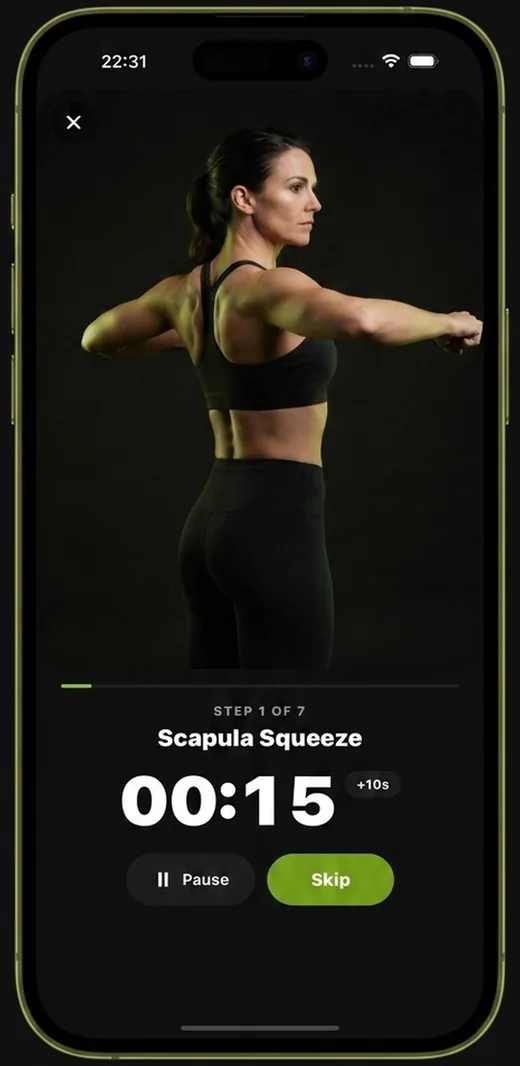
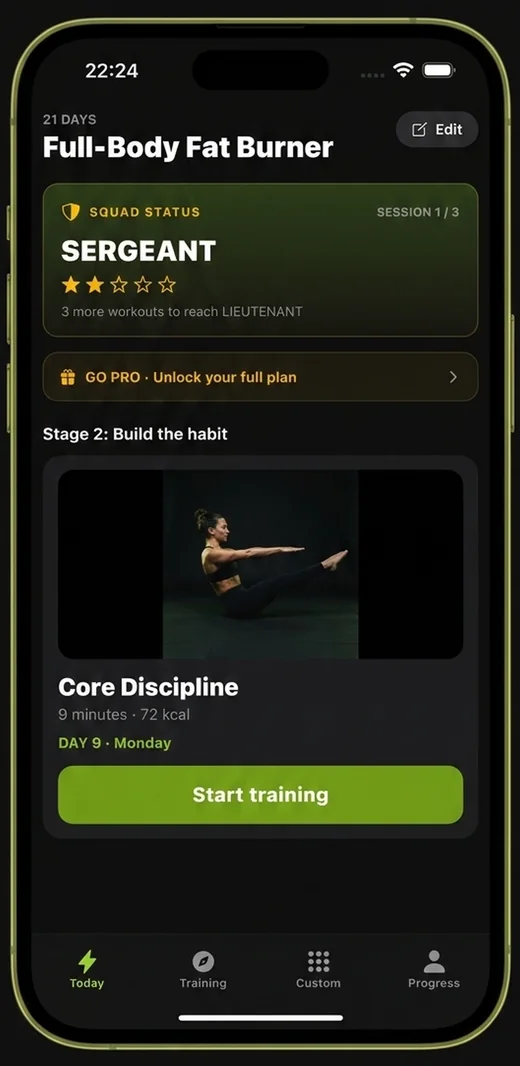
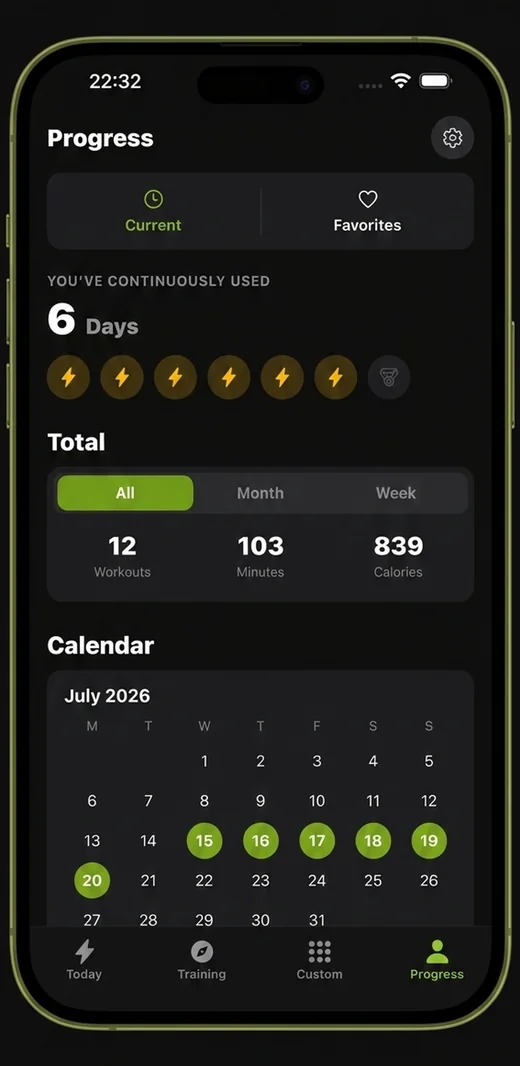
Military Calisthenics Coach builds you a personalized military-style calisthenics plan for iPhone: guided 5–30 minute bodyweight sessions you can run in a barracks, a garage or a hotel room, with timed sets and rests, ranks and streaks.
- A personalized plan that steps up after every 4-week PT test
- Guided timed sessions — no counting, no guessing
- Build your own sessions by time, body zone or focus
 Noted — thanks. We build Android once enough readers ask.
The best lower ab exercises are the ones that make you curl your pelvis toward your ribs or hold it still while your legs move: reverse crunches, leg raises, dead bugs, hollow holds and hanging knee and leg raises. Your “lower abs” are not a separate muscle. They are the bottom half of the rectus abdominis, the same muscle as your “upper abs”. You cannot fully isolate them, but some exercises load that end of the muscle harder than crunches do.
This guide gives you eight bodyweight lower ab exercises, ordered from beginner to advanced, with form cues and a workout for each level. Before writing it, we checked what the guides already ranking for “lower ab exercises” recommend and compared their picks with the EMG research. A lot of them get it wrong.
The 8 best lower ab exercises at a glance
| # | Exercise | Level | What makes it a lower ab move | Equipment |
|---|---|---|---|---|
| 1 | Dead bug | Beginner | Legs move while the abs keep the pelvis still | None |
| 2 | Reverse crunch | Beginner | Curls the pelvis toward the ribs | None |
| 3 | Lying leg raise | Beginner → intermediate | Abs keep the lower back down against a long lever | None |
| 4 | Hollow body hold | Intermediate | Holds a posterior pelvic tilt under load | None |
| 5 | Flutter kicks | Intermediate | Hollow position plus moving legs | None |
| 6 | Incline reverse crunch | Intermediate | Reverse crunch against more gravity | Bench or slope |
| 7 | Hanging knee raise | Intermediate → advanced | Curls the pelvis while you hang | Pull-up bar |
| 8 | Hanging leg raise | Advanced | Same, with straight legs | Pull-up bar |
Work through them in order. Each one is harder than the one before it, so when an exercise gets easy, the next one is your progression.
Do lower abs exist?
Not as a separate muscle. The rectus abdominis, your six-pack muscle, runs as one sheet from the lower ribs and breastbone down to the pubic bone. The tendons that cross it make it look like separate blocks, but it is one muscle contracting as a unit. Your obliques sit on the sides, and the transverse abdominis wraps underneath as a deep layer.
The research on whether you can work the bottom half harder is mixed but consistent on one point: the difference is small.
- Lehman and McGill (2001) measured the upper and lower portions of the rectus abdominis in 11 lean, athletic people during curl-ups, leg raises and other trunk exercises. They found no differences between the two portions within or between exercises and concluded that any differences are small and may not matter for training.
- Sarti and colleagues (1996) tested 33 people. During a curl-up, the upper portion worked harder in people who did the move correctly. A posterior pelvic tilt, flattening your lower back by rolling your pelvis under, worked the lower portion harder than the curl-up, but only in the trained group who performed it correctly. In people with poor technique, both exercises worked both portions about the same.
So “lower ab exercise” is a useful label for one kind of movement: the pelvis moves toward the ribs, or has to stay locked while the legs move. The pelvic tilt is the part that matters. Done without it, most of these exercises become hip flexor exercises.
What 21 top-ranking lower ab guides recommend
We pulled Google’s US results for “lower ab exercises”, “lower abs workout” and “best lower ab exercises” in October 2026 and collected every article that lists specific exercises: 21 guides from sites including Healthline, Women’s Health, Men’s Health, Runner’s World, SELF, Peloton, Sweat, Centr, Garage Gym Reviews and Athlean-X. We grouped each exercise into a family (so “leg lowers”, “lying leg lifts” and “straight leg raises” all count as leg raises) and counted how many guides include each one.
| Exercise family | Guides that include it (of 21) |
|---|---|
| Leg raises / leg lowers | 15 |
| Mountain climbers | 15 |
| Reverse crunch | 14 |
| Front plank (and variations) | 11 |
| Dead bug | 9 |
| Scissor kicks | 9 |
| Flutter kicks | 8 |
| V-ups / jackknives / V-sits | 8 |
| Bicycle crunch | 7 |
| Hollow body hold | 6 |
| Hanging knee / leg raise | 5 |
| Bear plank / hold | 5 |
| Russian twist | 4 |
| Side plank | 4 |
| Glute bridge | 3 |
| The hundred | 3 |
Three things stand out.
- The consensus is mostly sound. Leg raises and reverse crunches, the two most-recommended pelvis-curling moves, appear in 15 and 14 of 21 guides.
- Mountain climbers are overrated as a lower ab move. They tie for first place, but the trunk only holds a plank while the knees drive in. Nothing curls the pelvis. They are a good conditioning drill, not a targeted lower ab exercise.
- The strongest bodyweight option is underused. A hanging knee raise with arm straps was among the highest-activation exercises in the 2006 Escamilla EMG study (more on that below), yet only 5 of 21 guides include any hanging raise. Many lists also pad themselves with moves that have nothing to do with the lower abs: Russian twists and side planks are rotation and side-bending work for the obliques, and glute bridges train the glutes.
What the EMG research says works best
The most useful study here is Escamilla and colleagues (2006). They measured upper and lower rectus abdominis, oblique, hip flexor and lower back activity in 21 healthy adults across traditional exercises like the crunch and sit-up, plus several ab devices.
Upper and lower rectus abdominis activity was highest in three groups of exercises:
- the Power Wheel (pike, knee-up and roll-out), a wheel you strap to your feet,
- the hanging knee-up with ab straps, where your upper arms rest in slings so grip is not the limit,
- the reverse crunch on a 30-degree incline.
The same study found high rectus femoris (front of thigh and hip flexor) activity in the Power Wheel pike and knee-up, the incline reverse crunch and the bent-knee sit-up. The authors warned that this may be a problem for some people with low back pain. The hardest lower ab exercises also work your hip flexors hard. That is fine for healthy people, but it is why form, and the pelvic tilt above all, matters.
Two of the three top groups are on our list (the incline reverse crunch and the hanging raises). The third needs a Power Wheel. A standard ab wheel is the closest cheap alternative, although the study did not test one.
How to do each exercise
For every exercise below, start by finding the posterior pelvic tilt. Lie on your back with your knees bent, then press your lower back into the floor by rolling your pelvis under and gently bracing your stomach. Keep breathing. Hold that contact throughout each rep. If your lower back peels up, the set is over or the exercise is too hard.
1. Dead bug
- Lie on your back. Lift your arms straight up over your shoulders and bring your knees above your hips, bent to 90 degrees.
- Press your lower back into the floor.
- Slowly lower your right arm overhead and straighten your left leg toward the floor, stopping just above it.
- Return and switch sides. That is one rep per side.
Make it easier: move only the legs, or only tap a heel down with the knee still bent. Make it harder: move slower, or hold the extended position for two seconds.
2. Reverse crunch
- Lie on your back with your hands by your sides, knees bent at 90 degrees over your hips.
- Exhale and curl your hips off the floor, bringing your knees toward your chest. Think “roll the tailbone up”, not “swing the knees in”.
- Lower slowly until your tailbone touches down, without letting your feet drop.
The movement is small. If your hips are not leaving the floor, you are only moving your legs. Push your palms into the floor for help at first.
3. Lying leg raise
- Lie on your back with your legs straight and your hands under your hips or by your sides.
- Tilt your pelvis so your lower back is flat on the floor.
- Keeping your legs straight, lift them until they are vertical.
- Lower slowly, and stop just before your lower back starts to arch, even if that is well above the floor.
Make it easier: bend your knees. A bent-knee leg raise is a much shorter lever. Make it harder: finish each rep with a small reverse crunch at the top, lifting your hips off the floor.
4. Hollow body hold
- Lie on your back with your arms by your sides and your lower back pressed down.
- Lift your shoulders and legs off the floor so your body forms a shallow banana shape. Keep your lower back on the floor.
- Hold for time.
Make it easier: bend your knees and keep your arms by your sides. Make it harder: straighten your legs, reach your arms overhead and lower both closer to the floor. The hollow hold is the base position for gymnastics skills such as the L-sit and the front lever.
5. Flutter kicks
- Set up a hollow position: lower back pressed down, shoulders slightly up, legs straight a few inches off the floor.
- Kick your legs up and down in small, quick alternating movements.
- Count each leg as one rep, or work for time.
Flutter kicks are a staple of military PT. To make them a lower ab exercise, not a hip flexor burnout, raise your legs higher (about 45 degrees) if your lower back starts to lift. Scissor kicks are the same idea, with the legs crossing side to side.
6. Incline reverse crunch
- Lie on a bench set to about 30 degrees with your head at the high end. Grip the bench behind your head.
- Bring your knees above your hips.
- Curl your hips off the bench toward your chest, then lower under control.
No bench? A firm slope or a few stair steps work too. Because you are now working uphill against gravity, this is a big jump from the floor version. It is one of the top-activating exercises from the Escamilla study.
7. Hanging knee raise
- Hang from a pull-up bar with your arms straight and your shoulders engaged, pulled slightly down.
- Stop any swing before you start.
- Raise your knees toward your chest and curl your pelvis up at the top. Lifting your knees to hip height is only a hip flexor exercise; the curl is the ab part.
- Lower slowly to a dead stop.
If your grip gives out first, build it with dead hangs, or use ab straps on the bar like in the EMG study.
8. Hanging leg raise
- Hang as above.
- Keeping your legs straight and together, raise them to hip height or higher. At the top, curl your pelvis up toward the bar.
- Lower slowly without swinging.
Once you can do strict straight-leg raises to the bar for sets of 8 or more, you are ready for toes-to-bar and the dragon flag.
Lower ab workout by level
Do the workout for your level two to four times a week, after your main training or on its own. Rest 45 to 60 seconds between exercises and move to the next level when you can finish every set at the top of the range with clean form.
| Recruit (beginner) | Soldier (intermediate) | Operator (advanced) | |
|---|---|---|---|
| A | Dead bug, 3 × 8–10 per side | Hollow body hold, 3 × 20–40 s | Hanging leg raise, 4 × 6–10 |
| B | Reverse crunch, 3 × 8–12 | Incline reverse crunch, 3 × 8–12 | Incline reverse crunch, 3 × 12–15 |
| C | Bent-knee leg raise, 3 × 8–12 | Hanging knee raise, 3 × 8–12 | Straight-arm hollow hold, 3 × 30–45 s |
| D | Hollow hold, knees bent, 3 × 15–20 s | Flutter kicks, 3 × 20–30 s | Flutter kicks, 3 × 40–60 s |
| Time | About 12 minutes | About 15 minutes | About 18 minutes |
For a complete core session that also covers rotation and side planks, pair this with the calisthenics core workout.
Lower ab exercises for women and men
The exercises are the same. The muscle is the same, and so is the way to train it. Women carry more body fat than men on average, so visible lower abs usually take a lower body fat level to show. Ab training will not change that. Losing overall body fat will.
One exception: if you are pregnant, postpartum or see a ridge or dome along the middle of your stomach when you crunch, see a doctor or a pelvic health physiotherapist before doing leg raises and hanging work.
Why you can’t see your lower abs (yet)
Lower ab exercises strengthen the muscle. They do not burn the fat on top of it. In Vispute and colleagues (2011), 24 sedentary adults were split into two groups. One group did seven ab exercises, two sets of ten reps, five days a week for six weeks. Compared with the group that did nothing, they did not lose any belly fat, waist circumference or body fat percentage. Their ab endurance did improve.
You cannot choose where your body loses fat first. What works is total activity and diet. See calisthenics for weight loss and the calisthenics diet guide for that side.
Common mistakes
- Letting the lower back arch. This is the most common mistake. As soon as your back lifts off the floor, your hip flexors pull on your spine and your abs stop doing the work. Bend your knees or shorten the range.
- Swinging. In hanging raises and reverse crunches, momentum does the work that your abs should. Pause at the bottom of each rep.
- Lifting the legs instead of curling the pelvis. In reverse crunches and hanging raises, the hips should move. If only your legs move, it is a hip flexor exercise.
- Chasing reps instead of progressing. Fifty sloppy flutter kicks do less than ten slow hanging knee raises. Move to the next exercise on the list.
- Training abs every day. Your abs recover like any other muscle. Give them rest days between hard sessions.
Frequently asked questions
What is the best lower ab exercise?
For most people, the reverse crunch. It curls the pelvis toward the ribs, needs no equipment and scales from a short bent-knee version to a 30-degree incline. In a 2006 EMG study, the incline reverse crunch and the strap-supported hanging knee raise were among the exercises with the highest upper and lower rectus abdominis activity. Once you can hang from a bar, hanging knee and leg raises are the next step.
Can you target your lower abs?
Only a little. The rectus abdominis is one muscle running from your ribs to your pubic bone. A 2001 EMG study by Lehman and McGill found no differences in activity between its upper and lower portions within or between exercises, and called any differences small. A 1996 study found posterior pelvic tilts worked the lower portion harder than curl-ups, but only in trained people who did the move correctly. Pick exercises that curl the pelvis, but do not expect to isolate the lower abs.
What is the hardest lower ab exercise?
Among bodyweight moves, the strict hanging leg raise, with straight legs lifted to the bar or at least to hip height without swinging, is the hardest on this list. Toes-to-bar and the dragon flag are harder still, but they also demand a lot of grip, lat and shoulder strength.
Do lower ab exercises burn lower belly fat?
No. In a 2011 study, sedentary adults did seven ab exercises five days a week for six weeks. Their abdominal fat, waist circumference and body fat percentage did not change, though their ab endurance improved. Lower belly fat comes off with overall fat loss from diet and total activity, not from training the muscle underneath it.
How often should I do lower ab exercises?
Two to four times a week is enough for most people. Treat them like any strength exercise. When you can do every set at the top of the rep range with clean form, move to the next harder exercise rather than adding endless reps.
Why do I feel lower ab exercises in my hip flexors or lower back?
Your hip flexors lift your legs in every leg raise, so feeling them is normal. If your lower back arches off the floor, your abs have lost control of your pelvis and your hip flexors are pulling on your spine. Shorten the lever by bending your knees, reduce the range, or go back one exercise until you can keep your lower back down.
Sources
- Lehman GJ, McGill SM. Quantification of the differences in electromyographic activity magnitude between the upper and lower portions of the rectus abdominis muscle during selected trunk exercises. Physical Therapy, 2001
- Sarti MA et al. Muscle activity in upper and lower rectus abdominus during abdominal exercises. Archives of Physical Medicine and Rehabilitation, 1996
- Escamilla RF et al. Electromyographic analysis of traditional and nontraditional abdominal exercises: implications for rehabilitation and training. Physical Therapy, 2006
- Vispute SS et al. The effect of abdominal exercise on abdominal fat. Journal of Strength and Conditioning Research, 2011
- Guide analysis: Google US organic results for “lower ab exercises”, “lower abs workout” and “best lower ab exercises”, collected through DataForSEO on October 24, 2026. 21 articles with exercise lists were included. Video results, social posts and pages with no exercise list were excluded.