Sprint-Drag-Carry: AFT Rules, Standards by Age and a 6-Week Plan
Army Sprint-Drag-Carry rules shuttle by shuttle, official AFT pass and max times for every age group, and a 6-week plan you can run without a sled.

Now on iPhone
Military Calisthenics Coach
Train military-style, one guided workout a day
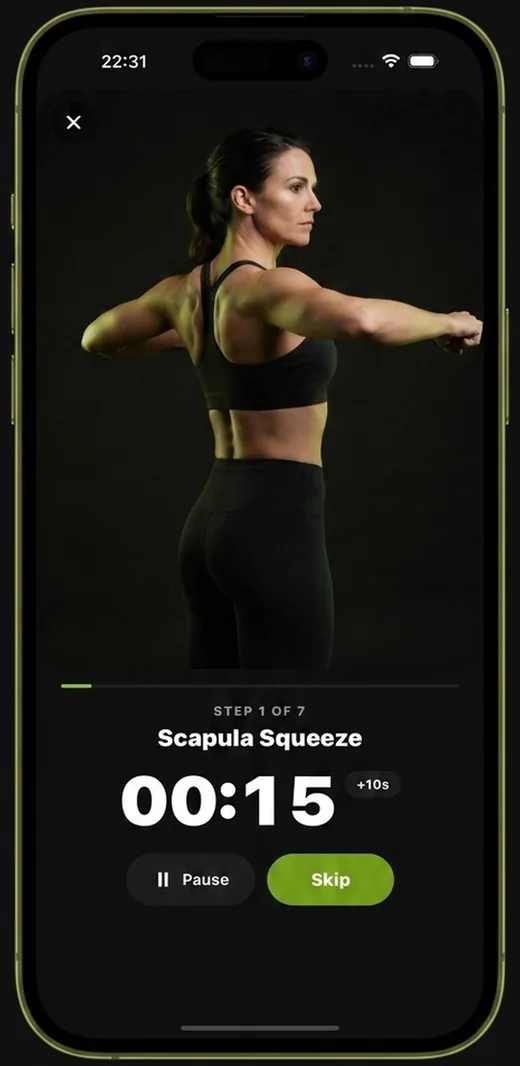
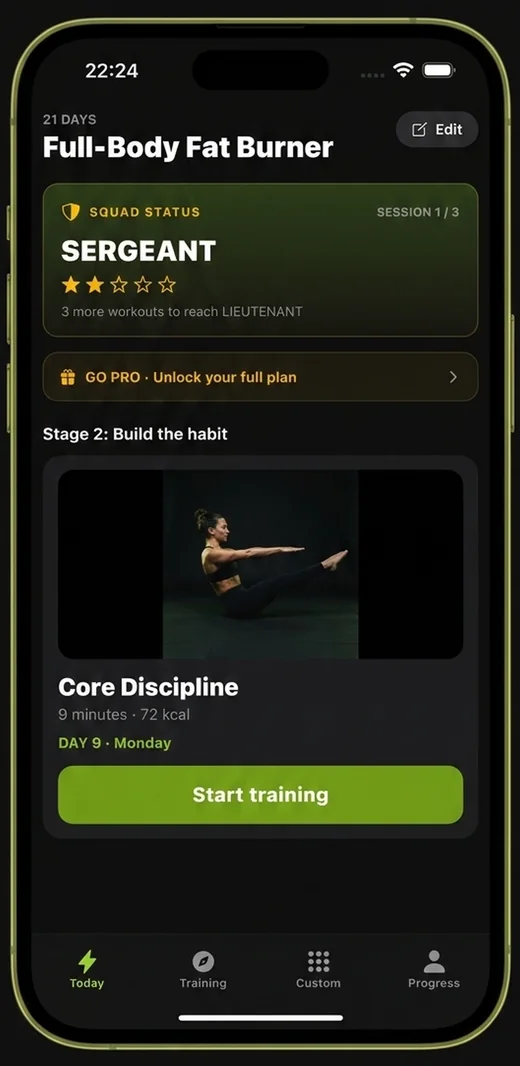
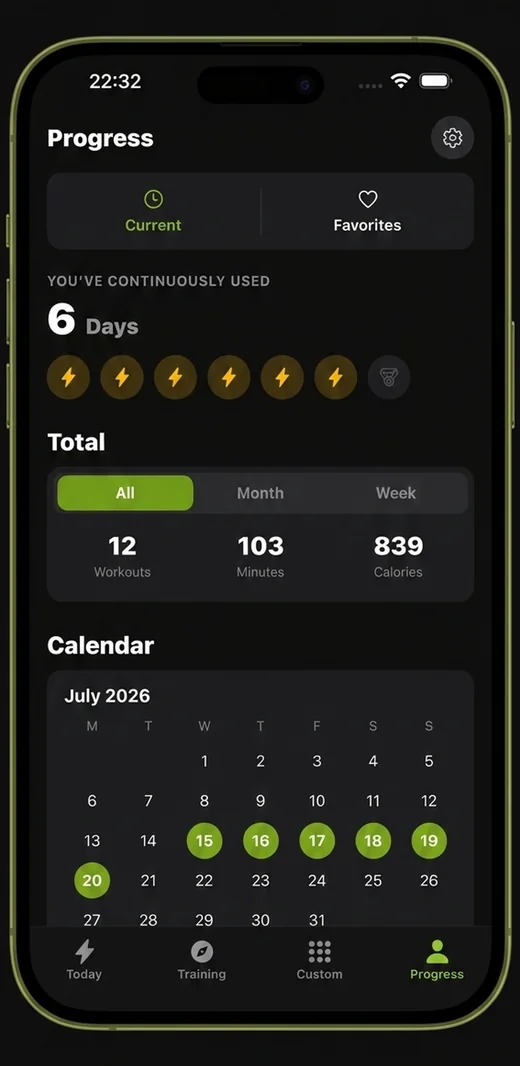
Military Calisthenics Coach builds you a personalized military-style calisthenics plan for iPhone: guided 5–30 minute bodyweight sessions you can run in a barracks, a garage or a hotel room, with timed sets and rests, ranks and streaks.
- A personalized plan that steps up after every 4-week PT test
- Guided timed sessions — no counting, no guessing
- Build your own sessions by time, body zone or focus
 Noted — thanks. We build Android once enough readers ask.
The Sprint-Drag-Carry (SDC) is a timed Army Fitness Test (AFT) event: five 50-meter shuttles on a 25-meter lane, 250 meters in total. In order, you sprint, drag a 90-pound sled backward, shuffle laterally, carry two 40-pound kettlebells, and sprint again. To pass you need 60 points, which is 2:28 for men and 3:15 for women aged 17 to 21, with more time allowed as you get older.
This guide covers the rules for each shuttle, the faults that cost you time, the official pass and max times for every age group, and a six-week plan you can run with a strap, a heavy bag and two water jugs. The standards come from the Army’s Army Fitness Test Score Tables (effective 1 June 2025). The rules come from goarmy.com and the Army testing manual, ATP 7-22.01 (March 2026). Both can change, so check the current versions before an official test.
How the Sprint-Drag-Carry works
Setup. Each lane is 25 meters long with a start line and a turn line. The sled (two 45-pound plates on a nylon sled, 90 pounds) and the two 40-pound kettlebells sit at the start line.
Surface. The 90-pound load is for the standard surfaces, grass or artificial turf. On a modified surface (a wooden gym floor, packed dirt, vinyl or smooth concrete) the sled carries four plates, 180 pounds, and the times needed do not change. The event is not run on gravel, unimproved dirt, a rubberized track or rubberized gym floor, ice or snow.
Start. On the command “GET SET,” lie face down with your hands under your shoulders and the top of your head behind the start line. On “GO,” the clock starts.
| Shuttle | What you do | At the 25-meter line |
|---|---|---|
| 1. Sprint | Get up from the ground, sprint 25 m, sprint back | Touch the line with a hand and a foot |
| 2. Drag | Grab the strap handles and pull the sled backward 25 m, turn it around, pull it back | The entire sled must cross the turn line, and again the start line |
| 3. Lateral | Shuffle sideways 25 m leading with one foot, back leading with the other | Touch the line with a hand and a foot |
| 4. Carry | Pick up both kettlebells, run 25 m, run back, set them down | Touch the line with a foot |
| 5. Sprint | Sprint 25 m and back across the start line to finish | Touch the line with a hand and a foot |
Each shuttle starts where the last one ended, at the start line, and there is no rest between them. The clock stops when you cross the start line at the end of shuttle five.
Faults that cost you time
The clock keeps running whatever happens. If you miss a touch, or the sled does not fully cross a line, the grader calls you back to fix it while the clock runs. If you drop the kettlebells mid-carry, you pick them up and carry on from that spot. These are the rules graders watch for:
- Missing a touch. On the sprints and the lateral, touch the ground at or past the 25-meter line with a hand and a foot. On the carry, touch it with a foot. Miss one and you are called back to make it.
- Turning the sled early. The whole sled, not just you, has to cross the 25-meter line before you turn it, and cross the start line again before you start the lateral.
- Crossing your feet on the lateral. Your feet must not cross; keep them parallel. You face the same direction going out and coming back.
- Using a wrong grip on the sled. The manual allows three grips: fingers through the loops, hands all the way through the loops holding the strap below them, or hands on the sewn part of the strap below the loops. The strap must not be twisted, wrapped or knotted.
- Dropping the kettlebells. Carry them at your sides, handles up, with a closed grip. If you drop them during the carry, you pick them up and continue from the spot where they landed. If you drop them at the start line, you are called back to set them down under control.
AFT Sprint-Drag-Carry standards by age
To pass the AFT you need at least 60 points on every event. The table below gives the time for 60 points (the minimum), 80 points and 100 points (the maximum). Faster is better, so you need that time or less.
| Age | Men and combat: 60 pts | Men and combat: 80 pts | Men and combat: 100 pts | Women: 60 pts | Women: 80 pts | Women: 100 pts |
|---|---|---|---|---|---|---|
| 17–21 | 2:28 | 1:53 | 1:29 | 3:15 | 2:28 | 1:55 |
| 22–26 | 2:31 | 1:53 | 1:30 | 3:15 | 2:29 | 1:55 |
| 27–31 | 2:32 | 1:55 | 1:30 | 3:15 | 2:29 | 1:55 |
| 32–36 | 2:36 | 1:58 | 1:33 | 3:22 | 2:34 | 1:59 |
| 37–41 | 2:41 | 2:02 | 1:36 | 3:27 | 2:38 | 2:02 |
| 42–46 | 2:45 | 2:07 | 1:40 | 3:42 | 2:44 | 2:09 |
| 47–51 | 2:53 | 2:14 | 1:45 | 3:51 | 2:50 | 2:11 |
| 52–56 | 3:00 | 2:23 | 1:52 | 4:03 | 2:58 | 2:18 |
| 57–61 | 3:12 | 2:29 | 1:58 | 4:48 | 3:07 | 2:26 |
| 62 and over | 3:16 | 2:32 | 2:09 | 4:48 | 3:07 | 2:26 |
Two scoring standards use these tables:
- General standard. Most Soldiers are scored by age and sex and need at least 300 points in total across the five events.
- Combat standard. Soldiers in the 21 combat specialties are scored on the men’s column regardless of sex (the official PDF labels it “M | C”) and need at least 350 points in total. This applies to the active component from 1 January 2026 and to the Reserve and National Guard from 1 June 2026.
Below 60 points, every extra second costs one point in every column. A man aged 17 to 21 who finishes in 2:38 scores 50 points and fails the event. Just above 60 the steps are wide: in that same column, going from 2:28 to 2:17 (11 seconds) earns only 2 points, while the next 24 seconds, from 2:17 to 1:53, are worth another 18 points.
One guide in our sample (last updated August 2023) still shows the original ACFT times (more on that below). The ACFT was replaced by the AFT on 1 June 2025. For current times, use one of the two AFT score table PDFs listed under Sources.
For the event before the SDC, see the hand-release push-up standards and plan. A passing AFT score does not exempt you from body composition rules either; see the Army height and weight standards.
How current are other Sprint-Drag-Carry guides?
We checked the pages that rank for Sprint-Drag-Carry searches against the official tables and found two things.
The SDC times did not change when the ACFT became the AFT. We compared the Sprint-Drag-Carry table in the ACFT score tables (as of 23 March 2022) with the AFT table effective 1 June 2025, cell by cell.
Of the 2,020 cells (101 point rows across 20 age-and-sex columns), 2,019 are identical. The one difference is in the column for men aged 52 to 56: the ACFT table listed 2:23 at both 79 and 80 points, and the AFT table leaves the 79-point cell blank. So no time scores differently.
What changed is who is scored on which column: under the AFT, Soldiers in combat specialties use the men’s column. An older ACFT page with the 2022 age-and-sex times still has the right numbers, but it will not tell you about the combat standard.
Most guides leave out the rules that matter now. Of the 17 pages we could read:
| What we checked | Pages (of 17) |
|---|---|
| Calls the SDC an AFT event (the rest describe only the ACFT) | 10 |
| Publishes SDC times that match the current table | 7 |
| Publishes SDC times that do not match it | 1 |
| Publishes no SDC times | 9 |
| Explains that combat-specialty Soldiers are scored on the men’s column | 4 |
| Mentions the 180-pound sled for gym floors and other modified surfaces | 0 |
| Gives a way to train the drag without a sled | 5 |
| Gives a multi-week plan | 2, both written around a sled and kettlebells |
The mismatched page gives 1:33 as the 100-point time and 3:00 as the passing time for everyone. Those are the times from the original ACFT scoring, which used the same time-to-points scale for every Soldier regardless of age or sex. For men aged 17 to 21 the current table says 1:29 and 2:28.
How we got this: on 30 October 2026 we pulled up to the top 30 Google US results for six Sprint-Drag-Carry searches (such as “sprint drag carry”, “sprint drag carry standards” and “sprint drag carry workout”). We kept every page that was not an Army or other government site or PDF, social media, a forum, a video or an app listing. One Google result could not be resolved to a URL, which left 20 pages.
Three of those blocked automated access, which left 17, and we coded each one by hand. The table comparison uses the ACFT and AFT score table PDFs listed under Sources. This is a snapshot of one day’s results, and pages change.
Technique for each shuttle
1. Sprint. Get up fast: push the ground away, bring one knee under you and drive out of a low start. Slow down over the last few steps so you can drop your hand to the line and turn in one motion. Do not run this one all-out. You have four more shuttles and the sled is next.
2. Drag. Face the sled, lean back, keep your arms long and your hips low, and take quick, short steps backward. Pull with your legs rather than your arms. At the turn line, check that the sled has fully crossed, then turn it around under control (goarmy.com warns against jerking the straps or slinging the sled) and drag it backward to the start line until the whole sled is over it.
3. Lateral. Stay low with your knees bent and push off the trailing leg. Lead out with one foot and lead back with the other, always facing the same direction. Keep your feet apart. Crossing them is a fault and an easy way to trip.
4. Carry. Grip the handles hard, stand tall and run with short, quick steps so the kettlebells do not swing into your legs. Step on or over the line with one foot, turn under control, and run back. Set the kettlebells down at the start line; do not throw them.
5. Sprint. Your legs and grip are tired by now, so this is where form slips. Make the hand-and-foot touch clean so you are not called back, and run through the start line, not to it.
Training without a sled or kettlebells
Most people cannot practice on Army equipment every week. These substitutes are close enough to train the movement and the effort:
| Event item | Substitute | Notes |
|---|---|---|
| 90-lb sled | A heavy sandbag, duffel bag or old tire dragged backward on grass with a rope or tow strap | Start with whatever you can drag at a steady walk and add weight over the weeks |
| Two 40-lb kettlebells | Two 5-gallon water jugs or buckets with handles | A US gallon of water weighs about 8.3 lb, so a full 5-gallon jug holds about 42 lb of water. Fill them halfway at first |
| 25-m lane | A football field: start on the goal line and mark the turn just over 2 yards past the 25-yard line | 25 meters is about 27.3 yards. Or measure it once with a tape and mark both ends |
A substitute will not feel like the real sled, and grass, bag and load vary a lot. Drag on grass or turf, the standard test surfaces. The setup section above covers indoor and other surfaces. Use the substitutes to train the pattern and the conditioning, then do at least one practice run on real equipment before your test if you can.
A 6-week Sprint-Drag-Carry plan
Two SDC sessions a week, on non-consecutive days, for example Tuesday and Friday. Keep the rest of your week for running, strength and the other events. Start every session with the Army Preparation Drill and finish with the Army Recovery Drill.
Session A: shuttles. All reps are 25 meters out and 25 meters back with the correct touch at the line. Rest 90 seconds between reps.
- Sprints from a prone start
- Backward drags with your substitute sled
- Laterals, leading out and back with opposite feet
Session B: carry and legs. Outside the time trials, this is the only session that trains the carry. Three or four rounds, two minutes’ rest between rounds:
- 1 carry: 25 meters out and back with both jugs or kettlebells
- 10 reverse lunges per leg
- 15 bodyweight squats
- 30-second farmer’s hold: stand still holding both jugs, for grip
For more lunge and squat variations, see the calisthenics leg workout.
| Week | Session A | Session B |
|---|---|---|
| 1 | 4 sprints, 3 drags, 3 laterals | 3 rounds |
| 2 | 5 sprints, 4 drags, 4 laterals | 3 rounds |
| 3 | Time trial (below) | 4 rounds |
| 4 | 6 sprints, 5 drags, 4 laterals | 4 rounds |
| 5 | 3 half-runs (below), 4 minutes’ rest between them | 4 rounds |
| 6 | Early in the week: 3 sprints, 2 drags, 2 laterals | None. Run the time trial at the end of the week |
Time trial. The full event, all five shuttles, with a partner timing each shuttle as well as the total. Training alone, film it on your phone and read the times off the video. Write all six times down.
Half-run. Shuttles 1 to 3 back to back: sprint, drag, lateral, with no rest between them.
After the week 6 time trial: compare your splits with week 3. The shuttle that improved least gets one extra rep when you run the plan again: one more rep of it in Session A, or one more carry per round in Session B if it was the carry.
If you timed the run on real equipment and your total is still slower than your 60-point time, repeat weeks 4 to 6 before testing. With substitutes, the times will not match the table, so judge by the change from week 3 to week 6 instead. If you are on track, leave two or three easy days after the week 6 time trial, then take your record test.
If you are new to sprinting, run the first two weeks at about three-quarter speed to let your hamstrings and calves adapt. Stop a session if you feel a sharp pain at the back of the thigh.
Test-day pacing
- Hold back on the first sprint. A hard first sprint leaves your legs flat for the drag.
- Breathe on the carry. Run it quick but controlled; it sets up the final sprint.
- Touch every line properly. A call-back costs more time than any pace you can gain.
- Know your time. Look up your 60-point and target times in the table before test day.
Common mistakes
- Training only distance running. The 2-mile run will not prepare you for backward dragging, lateral shuffling or a loaded carry. Each shuttle needs its own practice.
- Skipping the drag. It is the hardest shuttle for most people to practice because it needs equipment. Improvise one.
- Never practicing the hand touch. Drop to the line in every training rep so it is automatic when you are tired.
- Testing on legs that are not ready. Leave two or three easy days between your last hard run and a record test, as the plan does after week 6. For conditioning between test cycles, our military burpee workout needs no equipment.
Frequently asked questions
How many meters is the Sprint-Drag-Carry?
It is 250 meters in total: five 50-meter shuttles on a 25-meter lane. Each shuttle goes out 25 meters to the turn line and 25 meters back to the start line, in this order: sprint, sled drag, lateral, kettlebell carry, sprint.
What is the passing time for the Sprint-Drag-Carry?
You need 60 points on the event. Under the AFT score tables effective 1 June 2025, that is 2:28 for men aged 17 to 21 and 3:15 for women aged 17 to 21. The time allowed grows with age. Soldiers in the 21 combat specialties are scored on the men’s column, whatever their sex.
What is a max score on the Sprint-Drag-Carry?
For men aged 17 to 21 a time of 1:29 or faster scores 100 points; for women aged 17 to 21 it is 1:55. The fastest requirement in the tables is 1:29, and the full list for every age group is in this article.
How heavy are the sled and kettlebells?
The sled is loaded to 90 pounds with two 45-pound plates, and you carry two 40-pound kettlebells, one in each hand. The loads do not change with age or sex. On a modified surface, such as a wooden gym floor, packed dirt or smooth concrete, the sled is loaded to 180 pounds instead.
Can I train for the Sprint-Drag-Carry without a sled?
Yes. Drag a heavy sandbag, duffel bag or old tire backward across grass with a strap, and carry two filled water jugs or buckets instead of kettlebells. Nothing feels exactly like the real sled, so try to do at least one practice run on real equipment before your test.
Is the Sprint-Drag-Carry still part of the Army Fitness Test?
Yes. As of late October 2026 it is one of the five AFT events, along with the deadlift, hand-release push-up, plank and 2-mile run. Talk of changing the test comes up regularly, so check army.mil before an official test.
Sources
- Army Fitness Test Score Tables, effective 1 June 2025 (army.mil, PDF)
- HQDA EXORD 218-25, Annex B: Army Fitness Test Score Tables (goarmy.com, PDF)
- Sprint-Drag-Carry (SDC), AFT event (goarmy.com)
- Army Fitness Test (army.mil)
- ACFT score chart, original scoring (Military.com)
- ACFT Score Tables, as of 23 March 2022 (army.mil, PDF)
- ATP 7-22.01, Holistic Health and Fitness Testing, 12 March 2026 (armypubs.army.mil, PDF)
- Army fitness test goes sex-neutral for combat jobs (Task & Purpose, April 2025)