FBI Fitness Test (PFT): Scoring Tables and an 8-Week Plan
The current FBI fitness test: pull-ups, 300 m sprint, push-ups and 1.5-mile run, full scoring tables for women and men, and an 8-week plan to 10 points.
Now on iPhone
Military Calisthenics Coach
Train military-style, one guided workout a day
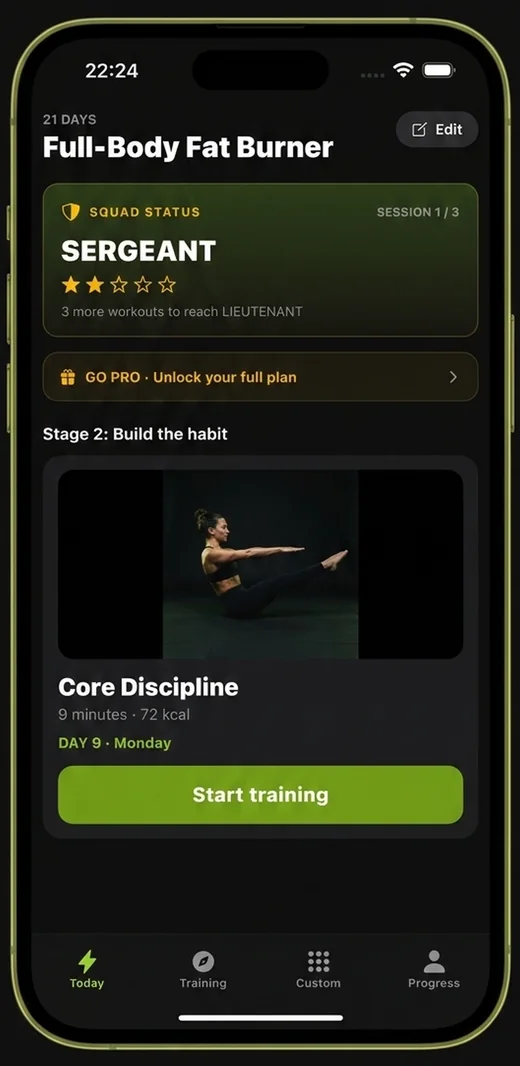
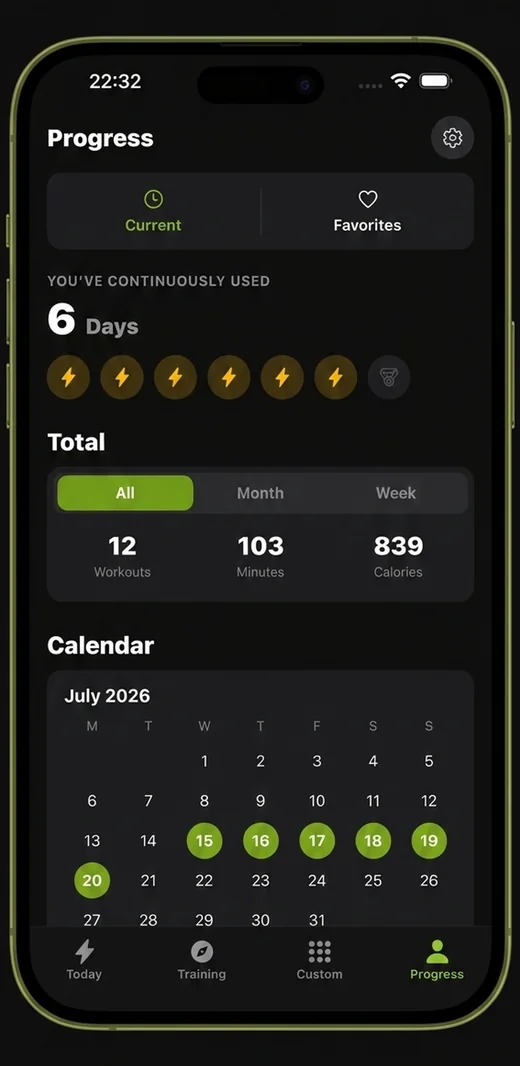
Military Calisthenics Coach builds you a personalized military-style calisthenics plan for iPhone: guided 5–30 minute bodyweight sessions you can run in a barracks, a garage or a hotel room, with timed sets and rests, ranks and streaks.
- A personalized plan that steps up after every 4-week PT test
- Guided timed sessions — no counting, no guessing
- Build your own sessions by time, body zone or focus
 Noted — thanks. We build Android once enough readers ask.
The FBI fitness test (the Physical Fitness Test, or PFT) is four events in a fixed order: maximum pull-ups or chin-ups, a 300-meter sprint, maximum push-ups and a 1.5-mile run, with no more than five minutes of rest between them. To pass, you need at least 1 point in every event and 10 points in total. Pull-ups replaced the one-minute sit-up in November 2025, and the pass mark dropped from 12 to 10.
This page gives the full scoring tables for women and men, explains how the points add up and where the easiest points are, and lays out an 8-week plan with a pull-up bar and a track. We also checked the pages that rank for three FBI fitness test searches on 7 November 2026: 11 of the 19 we could read describe only the old sit-up test.
Key takeaways
- Current events, in order: pull-ups or chin-ups, 300 m sprint, push-ups, 1.5-mile run. Sit-ups are gone.
- Pass mark: at least 1 point in each event and 10 points in total. A 0 or −2 in any event fails the test, whatever your total.
- The minimums add up to only 4 points. Two points in every event plus two more anywhere gets you to 10.
- Pull-ups score differently by sex: women earn 1 point per rep, men 1 point per 2 reps, both capped at 10 points.
- Our check of 19 ranking pages: 11 describe only the retired sit-up test (8 of them guides or training plans), and only 1 prints all four current tables for both sexes.
What is on the FBI fitness test?
The FBI gives the four events in this order, with no more than five minutes of rest between events:
| Order | Event | Scored by | What counts |
|---|---|---|---|
| 1 | Pull-ups or chin-ups | Continuous reps, untimed | Start from a dead hang with arms fully extended. Pull until your chin is over the bar, then lower back to straight arms. No kipping or swinging. Pull-ups and chin-ups score the same. |
| 2 | 300-meter sprint | Time | One all-out effort. |
| 3 | Push-ups | Continuous reps, untimed | Lower until your upper arms are parallel to the floor, then push back to straight arms. The event ends when you stop moving. |
| 4 | 1.5-mile run | Time | Six laps of a standard 400 m track is just short of 1.5 miles, so expect a little over six laps. |
Pull-ups and push-ups are both continuous-motion events. On push-ups, stopping to rest ends the event, so there is no resting at the top. On pull-ups, don’t plan on resting in the hang between reps either.
Before the official test, FBIJobs asks you to complete a self-evaluation of the same four events, to check that you can reach 10 points before your Meet and Greet. According to FBIJobs:
- your first official PFT must take place within 30 days of the Meet and Greet;
- if that first attempt scores under 6 points, or under 1 point in any event, you are withdrawn from the process (you may reapply);
- if it scores at least 6 with at least 1 point in every event but not 10, you get up to two more attempts within six months of the Meet and Greet;
- not passing within those six months means permanent disqualification from the Special Agent Selection System.
Process rules can change, so read the current wording on fbijobs.gov.
What changed in the FBI PFT in November 2025?
Until late 2025 the PFT started with sit-ups in one minute, and you needed 12 points. Pull-ups were scored only for applicants to the Tactical Recruitment Program. Since November 2025:
- the sit-up event is gone;
- pull-ups or chin-ups are event 1 and count for everyone;
- the pass mark is 10 points, still with at least 1 point in each event.
The sprint, push-up and run tables did not change. If a guide shows a sit-up table or a 12-point pass mark, its sprint, push-up and run numbers are still right, but its overall picture of the test is not.
What are the FBI fitness test scoring tables?
Each event is scored on a points scale that tops out at 10. The sprint, push-up and run scales start at −2; the pull-up scale starts at 0. Since you need at least 1 point in every event, any score of 0 or −2 means you fail, so in practice the only rows that matter are 1 to 10.
Event 1: pull-ups or chin-ups
| Points | Women | Men |
|---|---|---|
| 0 | 0 | 0–1 |
| 1 | 1 | 2–3 |
| 2 | 2 | 4–5 |
| 3 | 3 | 6–7 |
| 4 | 4 | 8–9 |
| 5 | 5 | 10–11 |
| 6 | 6 | 12–13 |
| 7 | 7 | 14–15 |
| 8 | 8 | 16–17 |
| 9 | 9 | 18–19 |
| 10 | 10 or more | 20 or more |
Event 2: 300-meter sprint (seconds)
| Points | Women | Men |
|---|---|---|
| −2 | 67.5 or slower | 55.1 or slower |
| 0 | 67.4–65.0 | 55.0–52.5 |
| 1 | 64.9–62.5 | 52.4–51.1 |
| 2 | 62.4–60.0 | 51.0–49.5 |
| 3 | 59.9–57.5 | 49.4–48.0 |
| 4 | 57.4–56.0 | 47.9–46.1 |
| 5 | 55.9–54.0 | 46.0–45.0 |
| 6 | 53.9–53.0 | 44.9–44.0 |
| 7 | 52.9–52.0 | 43.9–43.0 |
| 8 | 51.9–51.0 | 42.9–42.0 |
| 9 | 50.9–50.0 | 41.9–41.0 |
| 10 | 49.9 or faster | 40.9 or faster |
Event 3: push-ups
| Points | Women | Men |
|---|---|---|
| −2 | 4 or fewer | 19 or fewer |
| 0 | 5–13 | 20–29 |
| 1 | 14–18 | 30–32 |
| 2 | 19–21 | 33–39 |
| 3 | 22–26 | 40–43 |
| 4 | 27–29 | 44–49 |
| 5 | 30–32 | 50–53 |
| 6 | 33–35 | 54–56 |
| 7 | 36–38 | 57–60 |
| 8 | 39–41 | 61–64 |
| 9 | 42–44 | 65–70 |
| 10 | 45 or more | 71 or more |
Event 4: 1.5-mile run (minutes:seconds)
| Points | Women | Men |
|---|---|---|
| −2 | 15:00 or slower | 13:30 or slower |
| 0 | 14:59–14:00 | 13:29–12:25 |
| 1 | 13:59–13:35 | 12:24–12:15 |
| 2 | 13:34–13:00 | 12:14–11:35 |
| 3 | 12:59–12:30 | 11:34–11:10 |
| 4 | 12:29–11:57 | 11:09–10:35 |
| 5 | 11:56–11:35 | 10:34–10:15 |
| 6 | 11:34–11:15 | 10:14–9:55 |
| 7 | 11:14–11:06 | 9:54–9:35 |
| 8 | 11:05–10:45 | 9:34–9:20 |
| 9 | 10:44–10:35 | 9:19–9:00 |
| 10 | 10:34 or faster | 8:59 or faster |
The FBI publishes these tables on its FBIJobs event pages, which block automated access. The tables above are as published by two independent sources that match each other cell for cell and match the FBI’s Event 1 page as shown in search results (see Sources). Confirm them on fbijobs.gov before your test.
How do you reach 10 points?
The 1-point line in every event adds up to only 4 points. You need 6 more, and the scales do not make every point equally hard to earn. Here is what 1, 2 and 3 points take in each event:
| Event | Women: 1 / 2 / 3 points | Men: 1 / 2 / 3 points |
|---|---|---|
| Pull-ups | 1 / 2 / 3 reps | 2 / 4 / 6 reps |
| 300 m sprint | 64.9 / 62.4 / 59.9 s | 52.4 / 51.0 / 49.4 s |
| Push-ups | 14 / 19 / 22 reps | 30 / 33 / 40 reps |
| 1.5-mile run | 13:59 / 13:34 / 12:59 | 12:24 / 12:14 / 11:34 |
Each cell is the slowest time or fewest reps that still earns that score.
A few things stand out:
- Men: the second push-up point is close. It takes 33 push-ups instead of 30. The third point needs 40.
- Men: the second run point is 10 seconds away. 12:14 instead of 12:24. The third point needs 11:34, another 40 seconds.
- Women: each pull-up is a full point. Going from 1 rep to 3 is worth 2 points, as much as taking a minute off the run (13:59 to 12:59).
- The sprint is tight for men. About 1.5 seconds separates each of the first few points (about 2.5 seconds for women), so a better start and a hard finish can earn a point.
One balanced way to reach 10 points (3 + 3 + 2 + 2):
| Event | Women | Men |
|---|---|---|
| Pull-ups (3 points) | 3 reps | 6 reps |
| 300 m sprint (3 points) | 59.9 s or faster | 49.4 s or faster |
| Push-ups (2 points) | 19 reps | 33 reps |
| 1.5-mile run (2 points) | 13:34 or faster | 12:14 or faster |
This is only one combination. You can move points to your strong events, as long as no event falls below 1. Two examples that also add up to exactly 10:
- A man who runs well but pulls poorly: 2 pull-ups (1 point), 51.0 s sprint (2), 40 push-ups (3) and an 11:09 run (4).
- A woman who pulls well but runs slowly: 5 pull-ups (5 points), 64.9 s sprint (1), 19 push-ups (2) and a 13:34 run (2).
Mind the 6-point floor on your first attempt. Per FBIJobs, a first official attempt under 6 points, or under 1 point in any event, ends your application (you can reapply later), while 6 to 9 points still leaves you two retests. So the first attempt counts most: plan for a margin above 10, because the test is judged strictly and nerves cost reps.
How current are other FBI fitness test guides?
We checked the pages that rank for FBI fitness test searches against the current test. Of 19 pages, 11 describe only the retired sit-up test. Three of those are news stories from 2015 to 2020 that were right when published. The other 8 are guides or training plans that people still use to prepare.
| What we checked | Pages (of 19) |
|---|---|
| Describe sit-ups as a scored event (old test only) | 11 |
| Describe the current test (pull-ups first, four events) | 7 |
| List no events at all | 1 |
| Give 10 points as the pass mark | 5 |
| Give 12 points (the old pass mark) | 5 |
| Give 9 points (and 12 to skip a retest) | 1 |
| Give no pass mark | 8 |
| Print all four current tables for women and men | 1 |
Seven of the 19 pages rank in the top 10 for at least one of our three searches. Three of those describe the current test, three describe the sit-up test, and one does not list the events. Sit-up pages can carry a current date anyway: one has “Prepare & Pass in 2026” in its title.
The FBI’s own FitTest app listing on Apple’s App Store still described “your sit-up ability” in the search snippet we collected. We did not check the app itself, so go by the FBIJobs event pages.
How we got this: on 7 November 2026 we pulled the top 30 to 40 Google US results for “fbi fitness test”, “fbi pft” and “fbi physical fitness test scoring”. We set aside videos, social media posts, forums, app listings, image pages and document-sharing sites, and fetched the remaining 29 web pages. Nine blocked automated access and one was about a different agency’s test, which left 19 pages, each coded by hand. This is one day’s results, and pages change.
How do you train for the FBI PFT in 8 weeks?
Four sessions a week (three in the mock-test weeks), for example Monday, Tuesday, Thursday and Saturday. You need a pull-up bar, a track or a flat measured route, and a stopwatch. Start every session with a 10-minute warm-up such as the Army Preparation Drill.
Before week 1: mock test. Run the full PFT in order with five minutes’ rest between events and score yourself. Write down your pull-ups, sprint time, push-ups and run time. “Max” below means your score from your latest mock test.
Day 1: strength.
- Pull-ups: 5 sets of half your max (rounded down), 2 minutes’ rest between sets. If your max is 0 or 1, do 5 slow negatives instead: jump or step to chin over the bar and lower yourself over 3 to 5 seconds.
- Push-ups: 5 sets of half your max (rounded down), 90 seconds’ rest between sets.
Day 2: speed. 200 m repeats at your goal 300 m pace, with 3 minutes of walking between repeats. Your target for each 200 m is two-thirds of your goal 300 m time: about 33 seconds for a 49.4-second goal, or 40 seconds for a 59.9-second goal. In weeks 5 to 7, start with one 300 m at goal pace and walk 5 minutes before the 200s.
Day 3: volume. Do 3 times your max pull-ups and 3 times your max push-ups in as many sets as it takes, resting when your form slips. If your pull-up max is 0 or 1, do 10 slow negatives instead. Finish with a 20-minute easy run.
Day 4: run. 400 m repeats at goal 1.5-mile pace, 90 seconds’ rest between repeats. To find your target lap time, divide your goal 1.5-mile time by 6 and take off about 1 second, since 1.5 miles is slightly more than six laps. Example: a 12:00 goal works out to 2:00 per sixth, so run each 400 m in about 1:59.
| Week | Day 1 | Day 2 | Day 3 | Day 4 |
|---|---|---|---|---|
| 1 | As written | 4 × 200 m | As written | 4 × 400 m |
| 2 | +1 rep per set | 5 × 200 m | As written | 5 × 400 m |
| 3 | +2 reps per set | 6 × 200 m | As written | 6 × 400 m |
| 4 | As written | 4 × 200 m | Skip | Mock test |
| 5 | As written | 1 × 300 m, then 5 × 200 m | As written | 6 × 400 m |
| 6 | +1 rep per set | 1 × 300 m, then 6 × 200 m | As written | 7 × 400 m |
| 7 | +2 reps per set | 1 × 300 m, then 7 × 200 m | As written | 8 × 400 m |
| 8 | As written | 4 × 200 m | Skip | Mock test |
“As written” uses your max from the latest mock test, so the numbers go up after the week 4 mock test. Keeping Day 1 as written and skipping Day 3 in weeks 4 and 8 keeps your arms fresh for the mock test.
Cap on the extra reps: never do more than your max minus 1 in a Day 1 set (but at least 1 rep). If the “+1” or “+2” would take a set over that cap, do the extra reps as slow negatives instead. If you are doing negatives instead of pull-ups on Day 1, do 6 negatives in “+1” weeks and 7 in “+2” weeks.
After the week 8 mock test, compare it with your first one. If you are at 10 points with a margin, take two or three easy days and book your test. If not, find the event where one more point is closest in the “How do you reach 10 points?” table, add one extra set of it (or one extra repeat for the sprint or run), and repeat weeks 5 to 8.
If pull-ups are your weakest event, our pull-up progression breaks the first rep down into stages. For push-up form and variations, see the push-up progression.
If you are new to sprinting, run the first two weeks of 200s at about three-quarter speed. Stop if you feel a sharp pain at the back of your thigh.
What should you do on test day?
- Pull-ups first, fresh. It is the only event you do rested, so warm up your grip and shoulders with a few easy hangs or partial reps before you start. A short dead hang is a good grip primer.
- Don’t spend the sprint on the first 100 m. Go hard but controlled out of the start, and hold your form in the last 100 m, where most people slow down.
- Use all five minutes. Walk, breathe and shake out your arms before the push-ups. Your legs will still be heavy from the sprint.
- Pace the run by laps. Know your lap time for the score you want, and check it every lap.
Which mistakes cost points on the FBI PFT?
- Training from an old guide. If your plan includes sit-up practice, it was written for the pre-2025 test.
- Practicing push-ups with a rest at the top. On test day, stopping ends the event. Train continuous sets.
- Training each event fresh. The sprint follows your pull-ups, the push-ups follow your sprint, and the run comes last. The mock tests are there to get you used to that.
- Aiming for exactly 10 points. One missed rep or a few slow seconds can take you under. Build a margin.
If you are also preparing for a police academy, our police academy workout covers academy-style conditioning.
Frequently asked questions
Does the FBI fitness test still include sit-ups?
No. In November 2025 the FBI dropped the one-minute sit-up and made pull-ups or chin-ups the first scored event. At the same time the pass mark went down from 12 to 10 points. Guides that still list sit-ups describe the old test.
How fast do you have to run 1.5 miles for the FBI?
The slowest time that still earns the 1 point you need is 12:24 for men and 13:59 for women. That is only the floor. Because you need 10 points across four events, most candidates should aim for 12:14 or faster (men) or 13:34 or faster (women), which is worth 2 points.
How many pull-ups do you need for the FBI?
Women score 1 point for a single pull-up and 1 more point for each extra rep, up to 10 points at 10 reps. Men need 2 reps for 1 point and score 1 more point for every 2 extra reps, up to 10 points at 20 reps. Zero reps for women, or 0 to 1 reps for men, scores 0, which fails the test.
How difficult is the FBI fitness test?
The 1-point minimums are within reach for a fit, trained adult, but scoring 1 point in all four events adds up to only 4. The other 6 points have to come from doing better than the minimum somewhere, and the events come back to back with no more than five minutes of rest.
How many times can you take the FBI PFT?
Up to three times. According to FBIJobs, your first official PFT comes within 30 days of your Meet and Greet, and you get up to two more attempts within six months. But a first attempt under 6 points, or with less than 1 point in any event, means you are withdrawn (you may reapply). Not passing within the six months means permanent disqualification from the Special Agent Selection System.
Do FBI agents have to pass a physical fitness test?
Special agent candidates must pass the PFT during selection. You also complete a self-evaluation of the same four events before your Meet and Greet. This article covers that applicant test; other FBI jobs and specialized teams can have their own requirements.
Where should you start?
The current FBI PFT rewards balance: four events, at least 1 point in each, and 10 points in total. Run a mock test this week, find your score in the tables above, and start the 8-week plan from there. If the first pull-up is your sticking point, begin with the pull-up progression.
Sources
- Special Agent Physical Requirements (FBIJobs)
- Event 1: Pull-ups/Chin-ups (FBIJobs)
- Special Agent Application and Evaluation Process (FBIJobs)
- FBI Physical Fitness Test App – Push-up Demo (FBI)
- 2025 FBI Physical Fitness Test: New Standards and Requirements (Stew Smith Fitness, 23 October 2025)
- FBI PFT Physical Fitness Test, full scoring tables (Sand & Steel Fitness, 18 July 2026)
- FBI Physical Fitness Test: scoring tables and training (dawtmilano.com, updated 20 October 2026)