Mastering the Muscle Up Progression: A Military Guide
Unlock your elite strength with this step-by-step muscle up progression. Master the pull-ups, transition drills, and false-grip techniques used in the military.

Military Calisthenics Coach
Take the drill with you
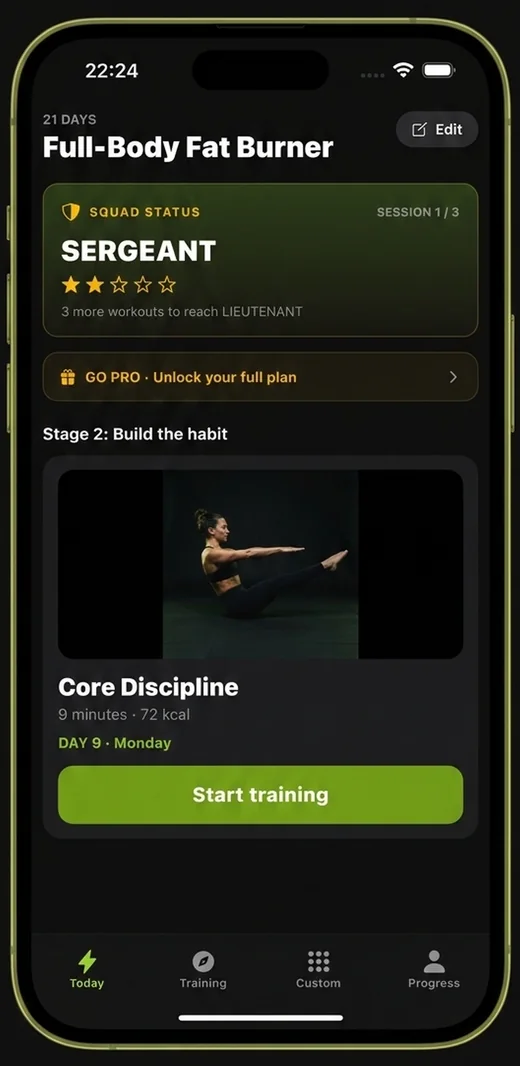
Everything on this site, built into a pocket coach. Military Calisthenics Coach turns the standards into a daily session you can run in a barracks, a garage or a hotel room — timed, tracked and scaled to you.
- A 21-day program that adapts to your level
- Guided timed sessions — no counting, no guessing
- Ranks, streaks and progress you can actually see



A professional-grade muscle up progression is the ultimate test of functional strength, demanding explosive power, coordination, and a seamless transition from a vertical pull to a horizontal push. For those following what military calisthenics is, the muscle-up is not just a parlor trick; it is a tactical necessity for scaling obstacles and climbing walls efficiently. To achieve this movement, you must stop viewing the pull-up and the dip as separate entities and start training the kinetic chain as one fluid unit. This guide will take you from basic pulling strength to the pinnacle of bodyweight mastery through a systematic, repeatable framework that builds the specific motor patterns required for the bar.
Prerequisites: The Foundation of Steel
Before you even attempt a muscle-up, your body must be capable of handling the eccentric load and the explosive peak force required. Many trainees attempt the movement too early, leading to shoulder impingement or frustration. You must first master the dead-hang to strict pull-up progression to ensure your back is ready to haul your body weight upward. Furthermore, you need to follow a dedicated dip progression to ensure your triceps can handle the lockout at the top of the bar.
The Mandatory Standards
Before starting this progression, you should be able to hit these numbers consistently:
| Movement | Standard | Metric |
|---|---|---|
| Strict Pull-ups | 15 Reps | Full ROM, Dead Hang |
| Straight Bar Dips | 20 Reps | Below Parallel |
| Explosive Pull-ups | 5 Reps | Bar to Lower Chest |
| False Grip Hang | 30 Seconds | Passive Hang |
If you cannot hit these numbers, return to your calisthenics for beginners foundations. Attempting high-level power movements without raw strength is a recipe for injury.
Phase 1: The False Grip and Lat Activation
The most significant technical hurdle for beginners is the false grip. Unlike a standard pull-up grip, the false grip requires you to place the heel of your palm over the bar rather than just your fingers. This shortens the distance your body must travel to reach the transition point. Spend your first four weeks strictly working on false-grip hangs. Your forearms will scream, and your grip strength will be tested to its limits. During these sessions, focus on “scapular retraction”—initiating the pull by pulling your shoulder blades down and back before your elbows even bend. This activates the lats and prepares your central nervous system for the explosive movement ahead.
Phase 2: Explosive Pull-ups and High-Pull Drills
A standard pull-up is not enough. You need explosive vertical velocity. To achieve this, incorporate “High-Pulling” into your training sessions. Utilize an explosive tempo (1-second up, 2-second controlled descent). Aim to pull the bar to your sternum, then your solar plexus, and eventually, your waist. If you find yourself stuck, incorporate band-assisted explosive pull-ups to get used to the feel of the higher pull trajectory. Perform 5 sets of 3-5 reps with 120 seconds of rest to allow your central nervous system to recover fully between explosive bursts. This is the engine of the muscle-up.
Phase 3: The Transition: Mastering the Turnover
The transition is where most trainees fail. It is the moment you move from the pulling phase to the pushing phase. You can practice this using low bars or a resistance band. While on a low bar, start in the dead-hang position, explosively pull, and aggressively “throw” your elbows over the bar, leaning your torso forward. Your goal is to keep the bar as close to your body as possible. Imagine you are trying to cut your chest in half with the bar. By practicing this on a lower bar, you remove the fear of the height while perfecting the motor pattern. Focus on the rapid snap of the wrists—a move that is significantly easier if you have already mastered the false grip in Phase 1.
Phase 4: The 6-Week Integration Plan
This plan assumes you have already mastered the prerequisites. Integrate these drills into your weekly routine, perhaps alongside the 20-minute no-gear barracks workout to maintain conditioning.
| Week | Focus | Primary Drills |
|---|---|---|
| 1-2 | False Grip & Lat Strength | 5x30sec False Grip Hangs, 5x5 High Pulls |
| 3-4 | Explosive Power | 5x5 Explosive Chest-to-Bar Pulls, 3x5 Slow Negatives |
| 5 | Transition Drills | 5x5 Low-Bar Turnover Drills, 3x5 Muscle-up Negatives |
| 6 | Attempt & Refine | 3 Attempts per session, 5 Sets of 3 Dips |
Troubleshooting the Muscle-up
Even with a perfect plan, you will encounter plateaus. If you find that you can pull to your chest but can’t complete the turnover, your lat strength might be sufficient, but your core engagement is lacking. Ensure you are not swinging wildly. While a slight kip is acceptable in tactical calisthenics, excessive kipping indicates a lack of raw power. If you are struggling with the transition, revisit your false grip positioning. Often, moving the wrist slightly further over the bar provides the leverage needed to snap over the top. If you have been training consistently and still aren’t progressing, incorporate weighted pull-ups into your routine to overload the muscle groups involved.
Frequently asked questions
Is the muscle-up strictly for upper body strength?
While the movement is dominated by the back, shoulders, and triceps, your core plays a critical role in stabilizing your body. Without a braced core, you lose the vertical momentum needed to clear the bar during the transition phase.
How long does it take to learn the muscle-up?
If you have already met the strength prerequisites, it typically takes 4 to 8 weeks of consistent, deliberate practice to master the transition. Do not rush the process, as the connective tissues in your elbows and shoulders need time to adapt to the explosive load.
Can I train muscle-ups every day?
No. This is a high-intensity, central nervous system taxing movement. Training muscle-up progressions 2-3 times per week is the sweet spot for recovery and progress, allowing your muscles to repair and your grip strength to solidify.
What if I fail the transition repeatedly?
If you are failing the turnover, stop trying to muscle up and go back to explosive high-pulls. You likely lack the necessary vertical velocity; pulling the bar higher will make the turnover phase significantly easier and prevent frustration and potential strain.